When you dive into phase‑shifting structured light, one term stops almost every engineer cold: Phase. If you’ve ever wondered how this Phase connects to the simple harmonic motion you learned in high school physics, you’re not alone. Today we’ll break it down in plain language, show why Phase is non‑negotiable for 3D sensing, and link it directly to reliable, industrial‑grade depth cameras you can use today.
Why Phase Is Indispensable in Phase‑Shifting Structured Light
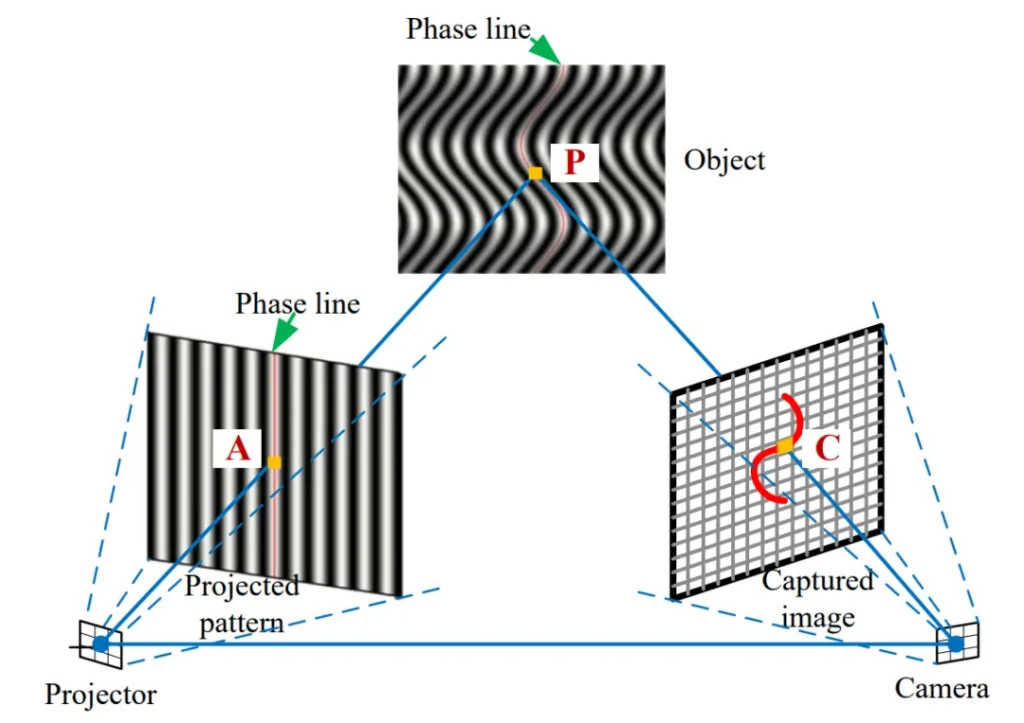
Phase‑shifting structured light works like a stereo vision system, but with a critical upgrade: it must match every camera pixel to a corresponding projector pixel. Without that precise pixel pairing, you can’t build a stable triangulation system—and you can’t calculate accurate depth.
Imagine projecting a clean set of sinusoidal stripes onto an object. Your camera captures the deformed pattern, but here’s the problem: identical stripes repeat across the frame. How do you know which stripe in the camera image matches which stripe from the projector?
That’s the core puzzle of structured light. You need a unique ID for every single stripe. And the answer is Phase.
Phase acts as a universal position marker. It turns repeating, ambiguous stripes into uniquely identifiable signals. Once you assign Phase values, every pixel knows exactly where it falls in the projected pattern—and depth calculation becomes possible.
Phase: The Hidden Position Code for 3D Depth
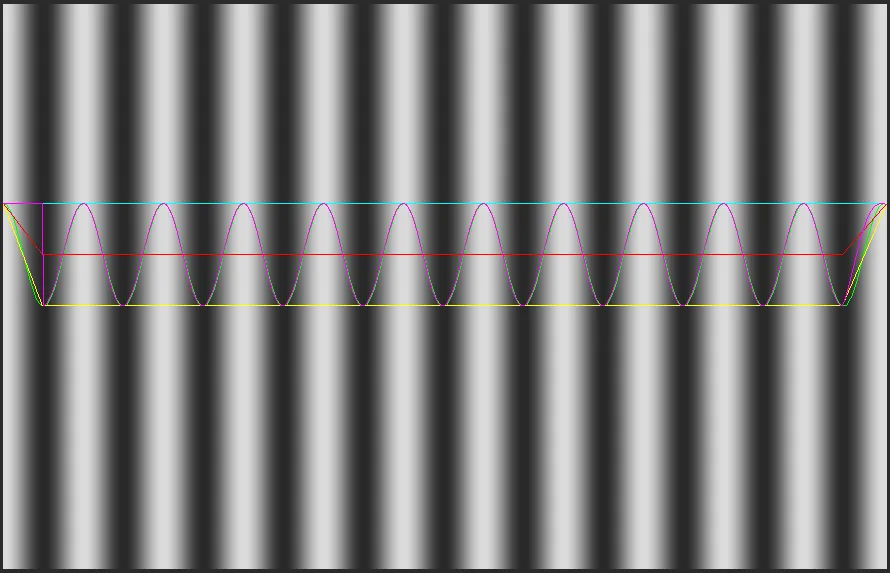
Let’s simplify this to its core. Think of projected sinusoidal stripes as a continuous wave. Every location along that wave can be labeled with an angle—that angle is Phase.
The formula for structured light intensity looks familiar:
I(x,y) = A + B cos(Phase + δ)
This is nearly identical to the simple harmonic motion equation. The big difference? In physics, Phase tracks motion over time. In structured light, Phase tracks position across space.
In short:
Phase = your position inside one full periodic wave
Each column of pixels shares the same Phase value. This creates a consistent, reliable coordinate system across the entire projected pattern. Flat surfaces show smooth, even Phase changes. Curved or elevated surfaces bend the stripes—and warp the Phase accordingly.
How Phase Translates Directly to 3D Shape
Here’s the magic: height changes = Phase changes.
- On a perfectly flat surface: stripes stay straight, Phase shifts linearly.
- On an object with height variation: stripes bend, Phase distorts visibly.
A single camera pixel will detect different Phase values at different object heights. That means Phase acts as a direct map to depth. By pairing camera Phase data with calibrated projector‑camera geometry (intrinsics + extrinsics), you reconstruct full 3D surfaces.
Take a pair of scissors on a flat platform as an example. The base platform has uniform height, so its Phase stays consistent. The raised blade changes the reflected light path, creating a clear Phase shift. These Phase differences become height differences in the final 3D model.
How Cameras Compute Phase from Captured Images
Calculating Phase requires solving multiple equations. The most common method is four‑step phase shifting:
- Project four sinusoidal patterns, each shifted by 𝜋/2
- Capture four frames with the camera
- Use intensity values at each pixel to solve for Phase
The result is a wrapped Phase map, limited to [0, 2π]. This map shows local shape but remains discontinuous across periods. To get a full, smooth 3D surface, you need phase unwrapping—often using Gray codes to label each stripe cycle.
Build Real‑World 3D Vision with High‑Performance Structured Light Cameras
Understanding Phase helps you appreciate why modern 3D depth cameras deliver such stable, precise results. These devices use advanced phase‑based structured light to handle reflective surfaces, dark environments, and fast motion better than older stereo or ToF systems.
If you’re ready to turn Phase theory into real‑world perception, two professional cameras stand out:
P100R 3D Depth Camera
Designed for mid‑range robotics and automation, the P100R uses polarization‑enhanced structured light to suppress reflection noise. It supports a depth range of 0.3–8m with ±1mm accuracy at 60cm, 640×400@30fps depth streaming, and a 72°×50.5° FOV. With a 40mm baseline, 90×25×25mm size, and USB Type‑C power & data, it’s ideal for AGVs, service robots, and medium‑distance inspection.
Learn more: https://myrobotproject.com/product/3d-depth-camera-p100r/
P008G 3D Depth Camera
Built specifically for close‑in robotic arm manipulation, the P008G offers an ultra‑short depth range of 0.08–1m with the same ±1mm high precision at 60cm. It features 1280×800@30fps depth and 1920×1080@30fps RGB, a 16mm baseline, compact 70×23.5×30mm body, and dual Fakra/Type‑C interfaces. It’s perfect for grasping, sorting, and precision assembly.
Learn more: https://myrobotproject.com/product/3d-depth-camera-p008g/
Key Differences Between P100R and P008G
| Feature | P100R | P008G |
|---|---|---|
| Depth Range | 0.3–8m | 0.08–1m |
| Baseline | 40mm | 16mm |
| Dimensions | 90×25×25mm | 70×23.5×30mm |
| Best For | Mid‑range robots, navigation | Robotic arms, close‑up inspection |
| Interface | Type‑C | Fakra / Type‑C |
Both cameras run on 2.5W low power, use 940nm eye‑safe Class 1 laser emitters, filter glare and reflections, and output synchronized RGB, depth, and point‑cloud data for plug‑and‑play 3D deployment.
Wrap‑Up
Phase is more than just a technical term—it’s the invisible coordinate system that makes precise 3D structured light sensing work. By turning stripe position into Phase values, cameras transform 2D images into accurate 3D shapes. Whether you’re building industrial scanners, robot vision, or automated inspection systems, mastering Phase helps you choose better hardware and build more reliable systems.
With high‑performance cameras like the P100R and P008G, you can deploy robust, phase‑driven 3D vision right away—no complicated R&D required.