What Is a Stereo Camera and How It Mimics Human Vision
Have you ever tried catching a ball with one eye closed? Close one eye, reach out your hand, and ask a friend to throw a ball toward you, then try to catch it.
You’ll find it hard to judge the ball’s speed and distance—you can clearly see the ball, but have no idea how far away it is right now. This happens because one single eye cannot sense depth. That’s exactly why robots need a Stereo Camera: to see the world in 3D, just like we do.
A Stereo Camera uses two lenses fixed at a set distance (called baseline) to capture two separate views of the same scene. The brain of the robot measures the tiny shift between the two images, known as disparity, and uses that to calculate exact depth and position. This is the same biological trick our eyes use every day.
Unlike a single-lens camera, a Stereo Camera produces real, absolute depth data without guessing. It doesn’t rely on deep learning or assumptions about object size—it simply measures what’s there.
[Place Image: Stereo camera disparity principle diagram]
Monocular Camera vs. Stereo Camera: Core Differences
Let’s break down the real difference between one-eyed and two-eyed robot vision.
Monocular Camera
A monocular camera is just a single webcam. It captures flat 2D images with color and texture, but no native depth. To guess distance, algorithms use:
- Object size clues
- Perspective and vanishing lines
- Motion parallax while moving
The biggest flaw is scale ambiguity—you can never be sure if an object is small and close or large and far. Monocular SLAM systems can only build relative maps, not true‑scale 3D environments.
Stereo Camera
A Stereo Camera delivers direct depth using stereo matching. It works on the pinhole camera model and epipolar geometry, which narrow down matching points to a single line, speeding up processing.
Common stereo matching algorithms:
- SAD / SSD: Fast, lightweight for embedded systems
- SGM: High accuracy, used in autonomous driving
- RAFT‑Stereo: Top‑tier precision with GPU support
The rule is simple: the wider the baseline, the better the precision. But depth accuracy drops quickly at long range—making Stereo Camera ideal for close and medium‑distance tasks.
Why Stereo Camera Dominates in Robotics
A Stereo Camera solves the biggest problem in robot vision: knowing exactly how far things are.
- It outputs real‑time depth without active lighting
- Near‑range accuracy (under 5m) is extremely reliable
- It works indoors and outdoors with consistent performance
- It provides full 3D positioning for grasping, navigation, and obstacle avoidance
This is why Stereo Camera systems appear in autonomous cars, industrial robot arms, humanoid robots, and drone obstacle avoidance modules.
Strengths and Weaknesses You Need to Know
Monocular Camera Pros & Cons
✅ Ultra‑low cost, tiny and lightweight
✅ High resolution and high frame rate
✅ Mature software support
❌ No absolute depth; scale unknown
❌ Struggles in low‑texture environments
❌ Sensitive to lighting changes
Stereo Camera Pros & Cons
✅ Direct, stable depth output
✅ Excellent close‑range precision
✅ Passive sensing (no projector needed)
✅ Works with SLAM and visual positioning
❌ Higher cost than monocular
❌ Accuracy drops at long range
❌ Needs texture for reliable matching
❌ Larger size due to dual lenses
Real‑World Uses of Stereo Camera Systems
Stereo Camera technology is everywhere in modern robotics:
- Autonomous vehicles using multi‑camera stereo vision
- Industrial robot arms for precise pick‑and‑place
- Humanoid robots with head‑mounted stereo vision
- Drones using stereo vision to avoid obstacles
- Indoor robots mapping and navigating without GPS
Wherever accurate 3D spatial awareness is needed, a Stereo Camera is often the best choice.
Top Stereo Camera Modules for Real‑World Robots
viobot2:
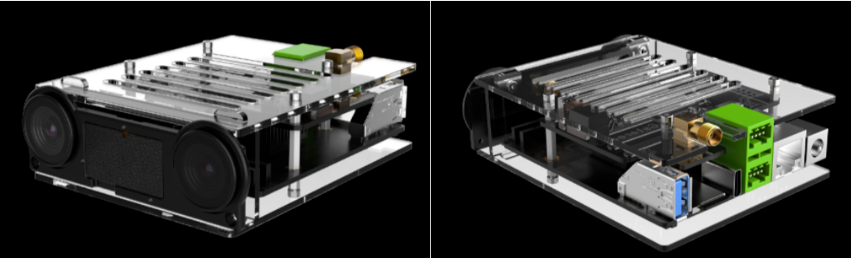
mini:
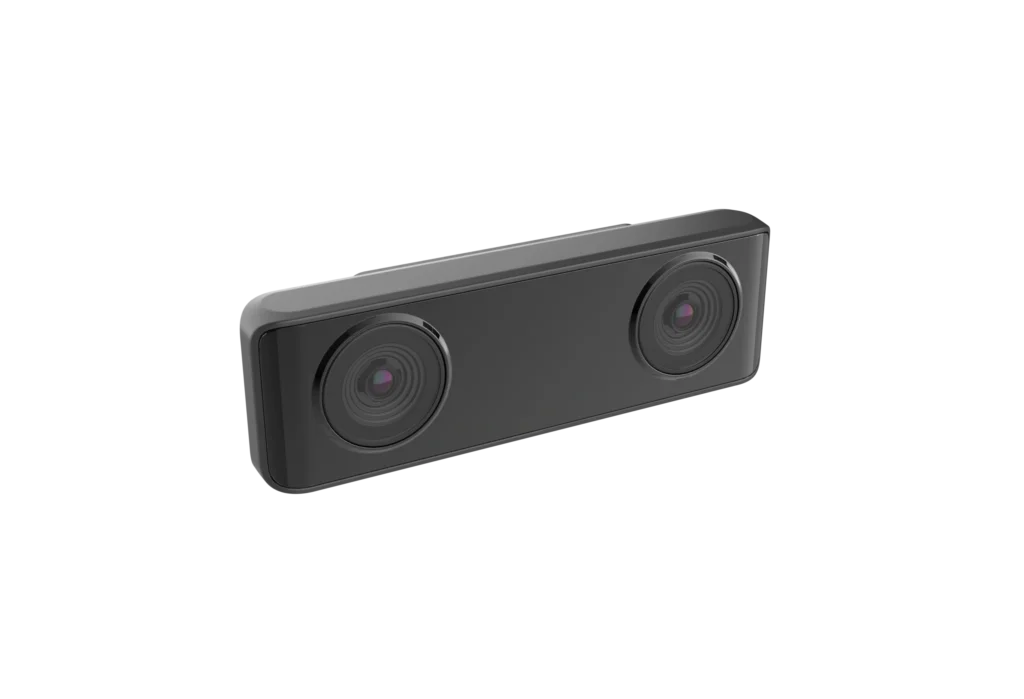
For reliable, ready‑to‑deploy stereo vision, two professional modules stand out: Viobot2 and RoboBaton Mini. The Viobot2 is an all‑in‑one Stereo Camera system with a powerful 3588 chip, 6TOPS NPU, IMU, GNSS/RTK support, 0.1–3m depth range, 164.7° ultra‑wide fisheye FOV, global shutter, 640×480@40fps, and rich interfaces including Ethernet and CAN. It’s built for high‑performance navigation, 3D reconstruction, and inspection. Learn more: https://myrobotproject.com/product/3d-stereo-vision-camera-viobot2/. The RoboBaton Mini is a compact, lightweight Stereo Camera at just 68g, IP68 waterproof, 5V low power (under 2.7W), RISC‑V K1 chip, IMU fusion, 6DOF pose output, and wide fisheye FOV. It’s optimized for drones, lawn robots, and small embedded systems. Learn more: https://myrobotproject.com/product/stereo-vision-camera-robobaton-mini/. Viobot2 offers full compute, multi‑sensor fusion, and industrial I/O for complex autonomous tasks, while Mini focuses on ultra‑small size, low power, and waterproof durability for lightweight mobile robots. Both deliver stable stereo depth and visual positioning to make robots truly see their world.