What Is Structured Light and How It Works for 3D Imaging
Structured Light is an active 3D measurement technology that projects coded light patterns onto objects, captures surface distortions, and calculates precise depth and shape data. Unlike passive vision, it does not depend on ambient light, so it works reliably in dark or low‑texture environments such as dim factory workshops and shadow‑covered assembly stations.
The idea is simple: shine a known pattern, watch how the object warps that pattern, then reverse‑engineer the 3D form. Imagine shining a flashlight on a flat wall—light stays straight. Shine it on a sculpture or human face—light bends with every curve and contour. That distortion is exactly what Structured Light uses to build accurate 3D models with fine detail.
Early systems used point or line scanning, which required moving parts and was slow for large‑area detection. Today’s area Structured Light captures full surfaces in one shot, greatly improving speed and stability. A well‑known everyday example is Apple’s Face ID, which uses infrared speckle Structured Light to map facial features quickly and safely for identity verification.
Types of Structured Light Systems
There are three main types of Structured Light scanning methods widely adopted across consumer and industrial fields.
- Point Structured Light: Simple in structure but limited to small‑object detection; not practical for large‑scale industrial scanning.
- Line Structured Light: Common in industrial inspection, uses a laser line paired with an industrial camera. It scans one line at a time but requires mechanical movement, which may reduce overall accuracy.
- Area Structured Light: Projects a full two‑dimensional pattern in one go. No moving parts, faster response, more stable data output, and widely used in high‑precision measurement and robotic vision applications.
Most industrial systems use phase‑shifting area Structured Light for the best balance of scanning speed and measurement accuracy.
4 Simple Steps: How Structured Light Measures Depth
Phase‑shifting area Structured Light follows four clear steps to create high‑quality 3D models for real‑world applications.
1. Project Coded Light Patterns
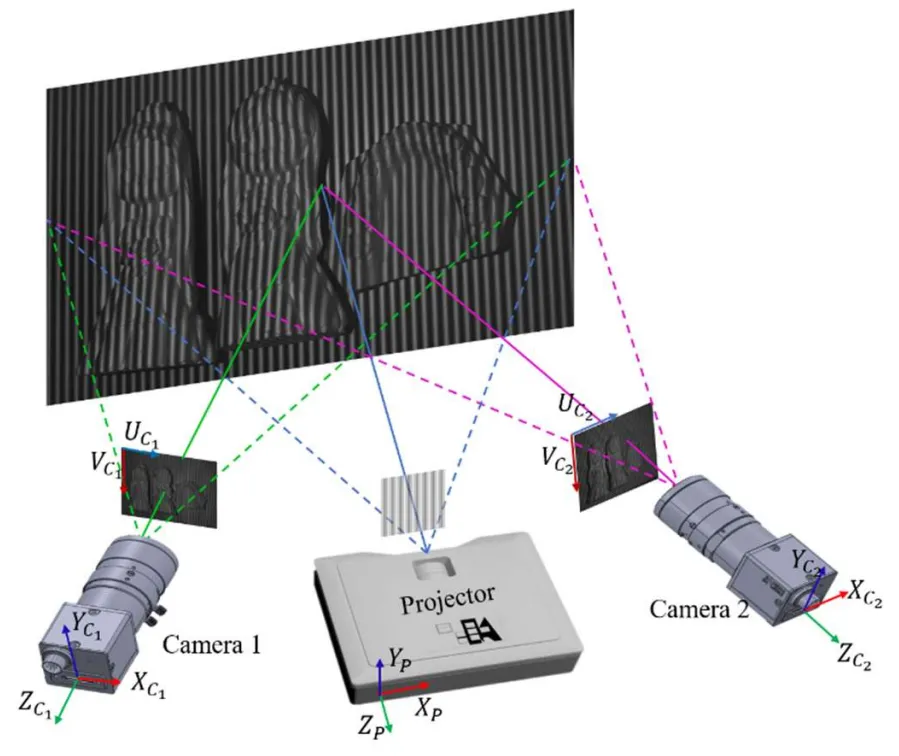
The system projects a series of phase‑shift sinusoidal fringes plus Gray code patterns in quick sequence. These unique codes give each pixel a fixed digital identity, making pixel matching extremely reliable. Gray code is preferred over standard binary code because it is more robust to environmental noise and sudden light interference.
2. Patterns Distort on Object Surfaces
When the light hits an object, straight fringes bend, stretch, or compress. Raised surfaces spread the pattern; indented areas squeeze it. Every deformation corresponds to a height change.
Nose protrudes → light dots stretch out
Deep eye sockets → light dots compress
Facial curved surfaces → overall pattern warps accordingly
3. Camera Captures and Matches Distortions
Dual high‑resolution industrial cameras record the warped patterns simultaneously. The system matches each deformed camera pixel to the original projector pixel using phase‑shift data. This stable stereo correspondence enables precise triangulation for depth calculation.
4. Calibration and Full 3D Reconstruction
Before formal use, the system calibrates with a standard calibration board to confirm the spatial positions of cameras and projectors. Using triangulation algorithms, it computes depth data for every pixel point and outputs a dense 3D point cloud or clear depth map for further analysis.
Key Advantages of Structured Light
Structured Light stands out for several strong practical reasons in industrial automation:
- Micron‑level precision, often replacing bulky coordinate measuring machines in modern production lines.
- Active built‑in illumination, performing stably even in complete darkness or low‑light scenarios.
- One‑shot full‑area scanning with no moving mechanical parts, lowering failure risks.
- Perfect for close‑range tasks: facial recognition, robotic arm grasping, precision dimensional measurement, and assembly positioning guidance.
Real Limitations of Structured Light
No technology is perfect. Structured Light has notable real‑world limits that users need to consider:
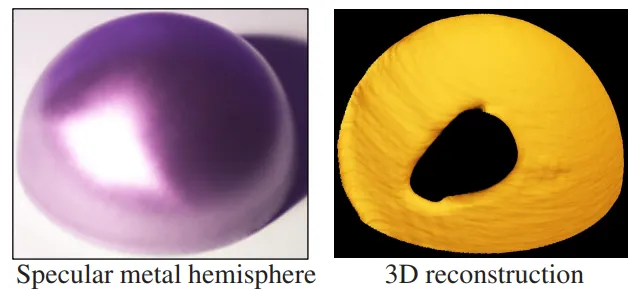
- Struggles under strong outdoor sunlight or on highly reflective surfaces like metal and glass, which can wash out projected light patterns.
- Effective working range is typically limited to 0.05–2 meters for optimal precision.
- Higher overall cost due to integrated projectors, industrial cameras, and dedicated processing algorithms.
Modern hardware and software designs use polarization modules and anti‑glare algorithms to greatly reduce these common issues.
Why Structured Light Is Ideal for Robotics and Industry
Today’s automated production systems and intelligent robots need fast, accurate 3D vision to complete core tasks such as object grasping, environmental navigation, product inspection, and automatic assembly. Structured Light provides the long‑term consistency and high precision robots demand, especially in stable controlled industrial environments.
Whether for tiny electronic part inspection or real‑time robot arm movement guidance, Structured Light delivers repeatable, high‑quality spatial data that basic depth sensors cannot match.
Ideal Structured Light Cameras for Modern Applications
For reliable, industrial‑grade 3D sensing tailored to different scenarios, two dedicated Structured Light cameras stand out: the P008G and P100R. The P008G is built for ultra‑close robotic manipulation tasks, with a depth range of 0.08–1m, ±1mm accuracy at 60cm, 940nm infrared anti‑glare technology, compact size (70×23.5×30mm, 77g), RGB 1920×1080@30fps resolution, and Type‑C/Fakra connectivity. Learn more: https://myrobotproject.com/product/3d-depth-camera-p008g/. The P100R supports longer‑range environmental perception, with a depth range of 0.3–8m, polarized projection to reduce reflection interference, ±1mm accuracy at 60cm, compact size (90×25×25mm, 72g), 640×400@30fps resolution, and USB Type‑C power supply. Learn more: https://myrobotproject.com/product/3d-depth-camera-p100r/. The P008G excels at short‑range, high‑precision pick‑and‑place operations, while the P100R is built for mid‑range AGV/AMR navigation and anti‑reflection stable detection. Both run on low 2.5W power consumption and support real‑time RGBD output to keep intelligent robots running smoothly.