LiDAR News Today: The Shift to Affordable $200 Solid-State Sensors and Why High-Performance dToF is Dominating 2025
The landscape of spatial perception is undergoing a tectonic shift. For years, “LiDAR news today” was dominated by $10,000 mechanical spinning assemblies reserved for high-end autonomous vehicle prototypes. Here’s the deal: as we move through 2025, that narrative has pivoted hard toward affordability, miniaturization, and the democratization of dToF (Direct Time-of-Flight) technology. The arrival of solid-state sensors in the sub-$200 bracket isn’t just a minor tweak; it’s a catalyst for a new era. We’re talking about a world where robotics, UAV development, and industrial automation treat 3D vision as a standard utility rather than a luxury line item.
In this comprehensive guide, we’re going to tear down the current market trends—everything from the integration of SPAD (Single-Photon Avalanche Diode) receivers to the death of mechanical failure points. We’ll also deep-dive into how hardware like the HM-LD1 DTOF Solid State LiDAR is finally bridging the gap between hobbyist budgets and industrial-grade performance. Look, whether you’re an engineer at a Tier-1 automotive supplier or a drone dev looking for a 28g obstacle avoidance solution, this blueprint covers the ground you need to stand on in the current LiDAR revolution.
Full LiDAR setups are powerful — but often too heavy, too complex, or just …
In the shop, we used to joke that LiDAR stood for “Look, I’m Doing A Research-project,” because the price kept it out of real-world production. That’s over. The shift to solid-state is the most significant move in sensing tech since the CMOS camera sensor. By removing the motors, we’ve removed the headache. We’re now seeing sensors that can outlive the robots they’re mounted on, and that changes the math for every project manager and lead engineer in the field.
Table of Contents
- 👉 I. The State of LiDAR in 2025: Breaking the $200 Barrier
- 👉 II. Mechanical vs. Solid-State: Why the Industry is Swapping Gears
- 👉 III. Understanding dToF & SPAD Technology: The Technical Core
- 👉 IV. Deep Dive: HM-LD1 DTOF Solid State LiDAR Specifications
- 👉 V. Overcoming the “Sunlight Blindness” Challenge in Industrial Sensors
- 👉 VI. Integration Architectures: UART, UDP, and UVC for Modern SDKs
- 👉 VII. Multi-Scenario Applications: From UAV Terrain Following to Security
- 👉 VIII. Expert FAQ: Addressing Reliability, Cost, and Accuracy
I. The State of LiDAR in 2025: Breaking the $200 Barrier
The industrial engineering sector has long awaited the “sweet spot” where high-frequency distance measurement meets consumer-level pricing. In 2025, we are seeing a massive transition led by pioneers like Luminar Technologies and specialized modular manufacturers. The primary driver here is the mass production of CMOS-integrated SPAD chips. By moving the complex light-processing onto silicon wafers, the manufacturing cost has plummeted even as the precision has gone through the roof.
Current LiDAR news today emphasizes that the market is no longer just about Level 5 autonomous cars. It is about the “Level 2 of everything”—adding basic spatial awareness to delivery bots, automated vacuum cleaners, and industrial safety curtains. For a senior industrial engineer, the implications are crystal clear: the cost of implementing a localized SLAM (Simultaneous Localization and Mapping) system has dropped by over 80% in the last 36 months. This allows for a density of sensors that was previously impossible, providing a 360-degree safety envelope for mobile robots using multiple solid-state modules rather than one expensive, temperamental spinning unit.
II. Mechanical vs. Solid-State: Why the Industry is Swapping Gears
Historically, LiDAR relied on mechanical rotors to spin a laser and a receiver 360 degrees. While effective for range, these systems are essentially “ticking time bombs” from a maintenance perspective. The Mean Time Between Failure (MTBF) is inherently limited by physical bearings and motor life. Plus, mechanical units are bulky, pull a lot of juice, and are picky about vibration—which is a disaster for drones or heavy machinery in a vibrating factory environment.
Solid-State LiDAR (SSL) like the HM-LD1 solves this by using a fixed optical path. There are zero moving parts. This leads to several critical advantages in industrial design:
- ✅ Durability: Highly resistant to shocks and vibrations that would shatter a mechanical mirror.
- ✅ Weight: Modern SSL modules weigh as little as 28g, compared to 500g+ for mechanical units. That’s a huge deal for flight times.
- ✅ Cost: Simplified assembly lines lead to lower CAPEX for robot manufacturers. Fewer parts means fewer things to pay for.
- ✅ Silent Operation: No more high-pitched whining from spinning rotors in quiet indoor environments.
According to the latest technical definitions from Wikipedia, Time-of-Flight sensors are evolving toward these non-mechanical flash or phased-array systems to meet the rigorous demands of 24/7 manufacturing environments. If you’re building for reliability, solid-state isn’t just an option; it’s the requirement.
III. Understanding dToF & SPAD Technology: The Technical Core
The real magic behind the current sensor revolution is Direct Time-of-Flight (dToF) coupled with SPAD (Single-Photon Avalanche Diode) technology. Unlike Indirect ToF (iToF), which measures phase shifts and gets confused by ambient light interference, dToF measures the actual travel time of individual photons. This is far more precise over long distances, especially when you’re working outside under the sun.
When a dToF sensor emits a pulse, the SPAD array acts as a hyper-sensitive biological eye, capable of detecting a single returning photon. This sensitivity allows the sensor to operate at lower power levels (making it eye-safe) while maintaining a solid signal-to-noise ratio even in bright sunlight. This technical leap is what enables a sensor weighing less than a lightbulb to map a warehouse floor with centimeter-level accuracy in real-time. It’s essentially the same tech found in high-end smartphones, but beefed up for industrial range and reliability.
IV. Deep Dive: HM-LD1 DTOF Solid State LiDAR Specifications
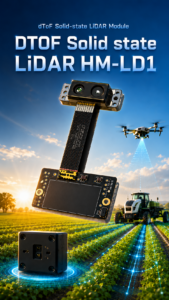
The HM-LD1 is the poster child for the 2025 LiDAR trend. It is a solid-state module specifically designed for integration into platforms where space and weight are tight, but you can’t afford to skip on reliability. Operating on SPAD dToF technology, it delivers real-time depth images and 3D point cloud data for environmental awareness that actually works.
Technical Dimensions & Performance Data
| Feature | Technical Specification | Industrial Advantage |
|---|---|---|
| Dimensions | 43.5mm * 30mm * 26.5mm | Tiny footprint helps with sleeker housing designs. |
| Ranging Capability | Indoor: 0.5-25m; Outdoor: 0.2-8m | Handles everything from hallways to pavements. |
| Ranging Accuracy | ±3cm | High-finesse precision for robotic docking. |
| FOV (Field of View) | 60°(H) x 45°(V) | Paints a wide picture for situational awareness. |
| Weight | 28g | Light enough for micro-UAVs and weight-sensitive drones. |
| Resolution | 40 * 30 (1,200 points) | Solid shape recognition for better avoidance. |
| Interface | UART / UDP / UVC | Talks to PCs and Raspberry Pi without a fuss. |
| Power Consumption | 1.2 W | Doesn’t kill your battery life in the field. |
View Product Details & Pricing ➔
V. Overcoming the “Sunlight Blindness” Challenge in Industrial Sensors
Look, one of the biggest hurdles for budget LiDAR has always been sunlight saturation. When you take a sensor outdoors, the ambient infrared radiation from the sun—often hitting over 80,000 lux—drowns out the sensor’s own laser signal. That’s why most “LiDAR news today” is obsessed with weather and outdoor performance.
The HM-LD1 fixes this with serious environmental adaptability. Its dToF architecture allows it to hold an 8-meter range even on a clear summer day. This isn’t just a spec-sheet win; it’s vital for:
- ✅ Bridge and Dam Inspection: Where the sun is intense and you can’t get a human close enough to see the cracks.
- ✅ Expressway Monitoring: Picking out vehicle outlines and lane intrusions in the glare of high noon.
- ✅ Last-Mile Delivery: Making sure the robot can actually navigate from the dark warehouse out to the bright sidewalk.
By hitting ±3cm accuracy across these conditions, industrial engineers can finally rely on a single sensor platform for both indoor and outdoor workflows without needing a stack of complex secondary sensors.
VI. Integration Architectures: UART, UDP, and UVC for Modern SDKs
A sensor is just a paperweight if you can’t talk to it. In 2025, developers want cross-platform support out of the box. The HM-LD1 supports UART, UDP, and UVC interfaces, which makes it a “plug-and-play” solution for everything from flight controllers to high-end PCs.
Getting your hands dirty with the data is easier now too. The crew at MRP (My Robot Project) offers full SDKs for x86 Windows, x86 Linux, and ARM Linux. If you’re building a ROS2 (Robot Operating System) node on a Raspberry Pi or an inspection tool on a Windows workstation, the data pipe is already there. For the engineer in the shop, this cuts the development cycle from months down to a few weeks. Startups can iterate faster and get their fleet in the air before the window closes.
⚙️ Technical Step 1: Connect via UART or USB for initial point cloud visualization.
⚙️ Technical Step 2: Leverage the SDK to filter noise and define your safety zones.
⚙️ Technical Step 3: Deploy the custom firmware to your ARM-based controller for real-time avoidance.
Download the DTOF SSL HM-LD1 Product Brochure
VII. Multi-Scenario Applications: From UAV Terrain Following to Security
The versatility of a 28g solid-state LiDAR is opening doors that used to be locked. Because the HM-LD1 provides both a point cloud and a depth map, you can use it for way more than just “stop-and-go” obstacle avoidance.
1. UAV & Drone Operations
Modern drones are using this tech for altitude hold and terrain following. In messy environments like forests or hillsides, the 10fps frame rate and wide FOV ensure the drone keeps its distance from the ground, even when moving fast. And since it only weighs 28g, your battery life isn’t going to take a hit.
2. AMR & Autonomous Robots
For Autonomous Mobile Robots (AMRs), this LiDAR is the “primary eye” for SLAM and volume measurement. It lets robots recognize objects, measure boxes for logistics, and keep an eye on “zone intrusions” in high-security zones. Being able to see 25m indoors means high-speed navigation through massive distribution centers is finally safe.
3. Smart Infrastructure & Cameras
We’re even seeing the HM-LD1 integrated into smart security cameras for user presence detection and autofocus. It can monitor a perimeter and trigger when a person enters a 3D zone, while ignoring a stray cat, which slashes the number of false positives in your security system.
a short-flex design and a long-flex design for different robotics and UAV d…
VIII. Expert FAQ: Addressing Reliability, Cost, and Accuracy
Is LiDAR technology finally becoming affordable for budget-conscious developers?
How does solid-state LiDAR compare to mechanical systems for drone and AGV integration?
Can affordable LiDAR sensors handle outdoor lighting and complex environments?
📚 References & Further Reading
- Industry Standard: Wikipedia: Time of Flight Principles
- Market Leader: Luminar Technologies: The Future of Automation
- Related Guide: User Guide: Integrating HM-LD1 with ARM Linux for Robotics