Anyone who’s taken photos with a phone knows the exact scenario: you grab your device to capture a dim dinner spread at a restaurant or a playful, darting pet mid-action, and end up with a crisp, vivid, well-balanced shot. Most people glance at camera specs—high megapixel ratings, premium glass lenses—and chalk up great image quality entirely to these hardware features. But sensor raw data is far from polished; it’s just a jumble of unrefined digital signals that can’t be viewed directly. The true workhorse behind every stunning photo is hidden deep within your device’s chipset: the ISP.
As a dedicated independent processing unit, the ISP runs nonstop in the background, turning rough light sensor data into clean, stunning photos in mere milliseconds. Now that compact camera lenses have nearly hit their physical design limits, the photography industry has fully leaned into computational imaging to boost picture quality. If you want to truly grasp how modern devices deliver professional-grade imagery, it’s essential to understand the core role that this powerful silicon component plays.
What Exactly Is ISP in Digital Imaging
Have you ever asked yourself how phones, security cameras and industrial vision systems manage to churn out clean, natural shots? Unlike the noisy, warped raw files straight off an image sensor, their final photos always look refined — and the credit goes to ISP technology. Short for Image Signal Processor, ISP combines custom hardware and software, positioned right between the image sensor and your screen or storage. Its main job is to take unprocessed pixel data and polish it into clear, usable imagery we can actually view.
Nearly every picture or clip you capture on a digital camera gets processed on the fly by this specialized chip. CMOS and CCD sensors don’t deliver perfect data out of the box; their raw outputs are full of unwanted grain, patchy color and uneven lighting. A well-tuned ISP fixes these issues one after another, tuning the picture to align with how our eyes see the world and holding up well across all kinds of shooting scenarios.
It now serves as a fundamental link in the entire imaging pipeline, used widely across everyday gadgets and high-end industrial equipment alike. Most people tend to fixate on megapixel counts or lens build quality, but they miss a key point: a powerful ISP is what keeps image quality steady and impressive. No matter how premium your camera hardware is, it will never reach its full potential without proper ISP calibration.
Core Functional Modules of ISP
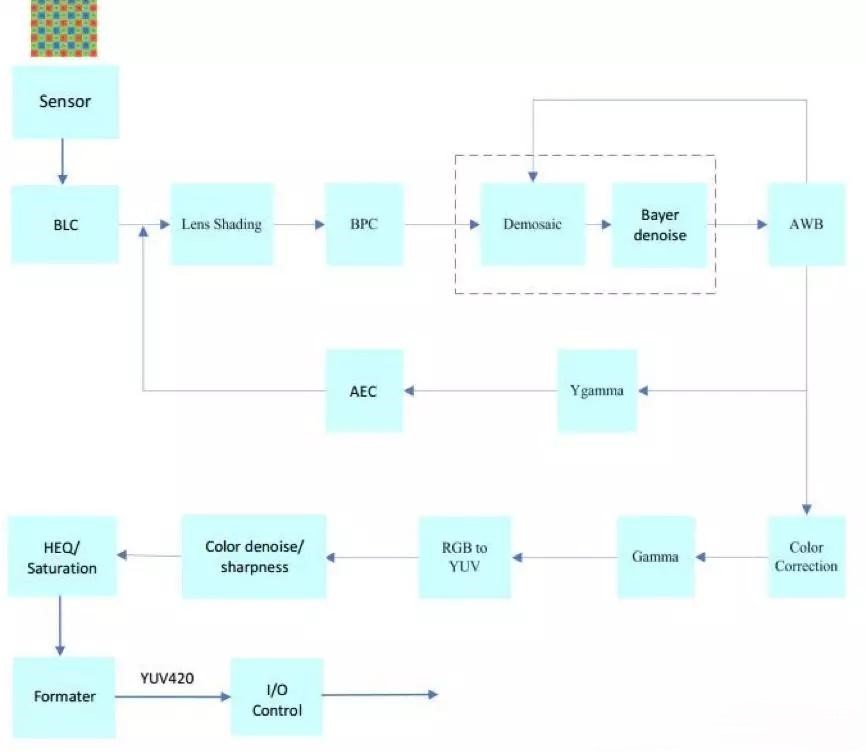
The comprehensive performance of this imaging processor relies on six essential functional modules, each undertaking unique tasks to optimize images. These modules work in tandem in the processing pipeline to solve different imaging problems from detail restoration to overall color and brightness adjustment.
Noise Suppression
Low light, high ISO settings and long exposure will generate digital noise on image sensors, appearing as scattered bright or colored spots that ruin image clarity. Noise suppression is one of the most basic functions of ISP. This module intelligently distinguishes real image details from noise points via built-in algorithms. It suppresses stray noise while preserving texture and edge information, instead of blurring the whole picture blindly. Whether you take photos indoors at night or shoot videos in dim outdoor scenes, this function effectively cleans up interference and keeps images clean and comfortable to view.
Demosaicing
Most image sensors adopt a color filter array, which means each single pixel only captures one primary color of red, green or blue. The original data lacks complete full-color information, so demosaicing becomes a necessary step for ISP. This module calculates and supplements missing color data of adjacent pixels through interpolation algorithms, restoring a complete full-color RGB image. Precise demosaicing technology prevents color aliasing and edge distortion, laying a solid foundation for subsequent image processing work.
Auto White Balance
Different light sources such as sunlight, tungsten lamps and fluorescent lights cast different color tones on scenes. Without correction, white objects will turn yellow, blue or other weird hues. The auto white balance module of ISP analyzes the color temperature of the shooting environment in real time, automatically calibrating color deviations and restoring true, lifelike colors. It works steadily under complex mixed lighting conditions, ensuring the color expression of images is always accurate and natural.
Auto Exposure
Too bright overexposed areas or too dark underexposed regions will make key subject details disappear. The auto exposure module of ISP continuously detects the overall brightness of the frame, dynamically adjusting sensor exposure time and signal gain. It balances the brightness of highlights and shadows, making both bright backgrounds and dark foregrounds clearly visible. This function allows users to capture qualified images without manually adjusting parameters, greatly simplifying shooting operations.
Sharpening
After multiple rounds of processing, images tend to lose edge sharpness and look soft and vague. The sharpening module of ISP enhances edge contour and texture details reasonably. It strengthens the contrast between adjacent pixels at edges to make outlines clearer, while avoiding over-sharpening that causes unnatural halos. Proper sharpening brings vivid details to portraits, landscapes and text scenes, greatly improving the visual impact of images.
Image Synthesis and Fusion
In high dynamic range shooting, multi-frame synthesis and scene fusion are required to integrate details from multiple exposed frames. The image synthesis and fusion module of ISP combines information from different frames, retaining rich details in both ultra-bright and ultra-dark areas. This module is widely used in HDR imaging, night mode and panoramic stitching. It maximizes the effective information of the original data and further upgrades the overall image quality.
AI Empowers the Evolution of ISP System
As artificial intelligence technology matures, traditional hardware-based image signal processors are stepping into a new intelligent iteration stage. In the past, the operation logic was based on fixed algorithm rules, which struggled to adapt to extreme scenes such as ultra-low light, strong backlight and complex textures. Now, AI algorithms are deeply embedded into the operation flow of ISP, bringing revolutionary changes.
AI models can learn massive image data, enabling the processor to recognize different scenes, subjects and lighting environments autonomously. When facing portrait shooting, the intelligent chip will prioritize skin color optimization and background blur; when capturing landscapes, it will strengthen color saturation and distant detail restoration. Compared with traditional fixed algorithms, AI-powered ISP has stronger adaptability and higher processing efficiency. It can complete complex processing tasks with lower power consumption, which is especially important for battery-powered mobile devices. More and more imaging manufacturers are combining lightweight AI inference engines with this core imaging chip, making real-time image processing smarter and more accurate.
Future Trends and Comprehensive Summary of ISP
Looking ahead, the development of image signal processing technology will move toward higher integration, stronger intelligence and lower power consumption. With the popularization of computational photography, 3D vision and vehicle-mounted imaging, the functional load keeps rising. Future designs will integrate more AI processing units to realize end-to-end intelligent image processing. Meanwhile, miniaturization and low power consumption will become core development directions to meet the demands of wearable devices, drones and in-vehicle cameras. Cross-device compatible algorithms and multi-sensor collaborative processing will also become mainstream upgrading directions.
To sum up, ISP is the invisible core supporting all digital imaging devices. From basic noise reduction and color correction to advanced AI intelligent optimization, every technical upgrade directly promotes the leap of image quality. Its six core functional modules build a complete image processing system, solving various pain points in sensor raw data. Driven by AI, modern imaging processing chips have broken the limitations of traditional technology and opened up broader application space. As imaging scenarios become increasingly diversified, the value of high-performance processing solutions will continue to stand out, leading the entire imaging industry to move forward steadily.