In the era of autonomous navigation, 3D perception is the foundation of intelligent machines. Traditional mechanical LiDAR, ultrasonic sensors, and stereo vision often suffer from poor stability, high power consumption, large size, or weak resistance to ambient light. For robots, drones, and smart devices that need reliable, real‑time, high‑precision environmental sensing, DTOF Solid State LiDAR has become the optimal choice.
This article fully explains what DTOF Solid State LiDAR is, how it works, how it measures distance, what types exist, its core components, real‑world applications, and why the HM‑LD1 represents the best implementation of DTOF available today.
What Is DTOF Solid State LiDAR
DTOF Solid State LiDAR (Direct Time-of-Flight Solid-State LiDAR) is an advanced 3D depth-sensing technology that directly calculates the distance between the sensor and a target by measuring the round-trip time of laser pulses.
Unlike traditional mechanical LiDAR, DTOF Solid State LiDAR has no rotating parts, no scanning motors, and no vulnerable moving components. It uses a stationary VCSEL laser array and SPAD detector array to emit laser signals and receive reflected light, enabling high-speed, high-reliability depth detection.
With its compact structure, low power consumption, and strong anti-interference ability, DTOF Solid State LiDAR is widely used in drones, autonomous robots, robotic dogs, industrial inspection, and educational research.
How DTOF Solid State LiDAR Works
The working principle of DTOF Solid State LiDAR is precise and efficient. It shares the basic physical logic of LiDAR but uses a fully solid-state architecture.
- A VCSEL laser emitter emits sub-nanosecond laser pulses (940nm eye-safe).
- Laser pulses travel through space and reflect off the surface of objects.
- A high-sensitivity SPAD array receives the reflected light signals.
- The processor calculates the exact time taken for the pulse to return.
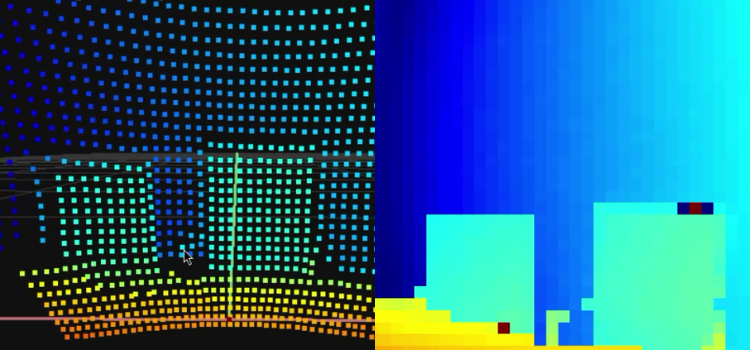
- Depth data is generated in real time and output as a depth map or point cloud.
Since the speed of light is constant, DTO can convert time differences into accurate distance values with almost no delay.
DTOF Solid State LiDAR Measurement Principles & Methods
DTOF Solid State LiDAR uses direct time-of-flight measurement, the most accurate and stable depth-sensing method available.
Distance Calculation
The core formula of DTOF Solid State LiDAR measurement is:
Distance = (Speed of Light × Time of Flight) ÷ 2
Since light travels at a constant speed, the system only needs to measure the exact time the laser pulse takes to travel to the object and return. This direct measurement method gives DTOF Solid State LiDAR strong resistance to ambient light, high precision, and stable output.
Measurement Process
- Emission: The module sends ultra-short laser pulses.
- Reflection: Pulses hit objects and bounce back.
- Detection: SPAD sensors capture reflected photons with high sensitivity.
- Calculation: Onboard chip computes distance per pixel.
- Output: Depth map, point cloud, and grayscale data are generated.
DTOF Solid State LiDAR supports measurement from 0.2m up to 25m indoors, with typical accuracy of ±3cm, making it ideal for short- to mid-range autonomous perception.
Key Measurement Parameters
- Indoor range: 0.5–25m
- Outdoor range: 0.2–8m
- Accuracy: ±3cm
- Field of view: 60°(H) × 45°(V)
- Ambient light resistance: Up to 80,000 lux
- Resolution: 40×30
- Frame rate: 10fps
These parameters ensure DTOF Solid State LiDAR performs reliably even in strong sunlight and complex environments.
Types of DTOF Solid State LiDAR
Although DTOF Solid State LiDAR belongs to the solid-state LiDAR family, it can be classified by application scenario, integration form, and functional design.
1. By Integration Structure
- Module-integrated DTOF: Highly integrated, small size, ready to use, such as HM-LD1.
- Board-level DTOF: For custom assembly and secondary development.
2. By Application Scenario
- Drone-optimized DTOF: Ultra-lightweight, low power, compact.
- Robot-adapted DTOF: High stability, strong vibration resistance.
- Industrial DTOF: Wide temperature resistance, long-term durability.
3. By Optical Architecture
- Area-array DTOF: The most common type, outputs full-frame depth images.
- Single-point ranging modules: Not true LiDAR, only for simple distance detection.
The HM-LD1 is a typical high-performance area-array DTOF that supports robots, drones, and research platforms.
Core Components
A complete DTOF Solid State LiDAR system includes several key components:
1. VCSEL Emitter
Emits 940nm Class‑1 eye-safe laser pulses with high speed and low power consumption.
2. SPAD Detector Array
High-sensitivity single-photon avalanche diode array that captures weak reflected signals.
3. Signal Processing Chip
Calculates time of flight at sub-nanosecond precision and outputs depth data.
4. Optical Lens System
Shapes the laser beam to ensure uniform illumination and stable reception.
5. Interface Circuit
Supports UART, UDP, UVC for easy integration into flight controllers and embedded systems.
Together, these components make DTOF compact, reliable, and high-performance.
HM-LD1: The Premium DTOF Solid State LiDAR for Robotics & Drones
The HM-LD1 from MyRobotProject is a professional DTOF Solid State LiDAR built for real-world autonomy.
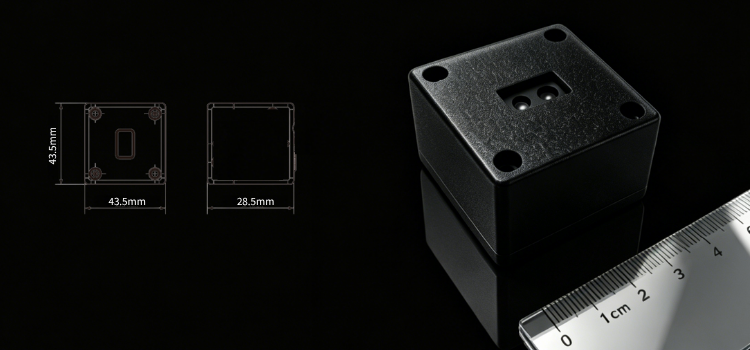
It uses hybrid stacked SPAD technology and 940nm VCSEL emitters, with a weight of only 28g and power consumption of just 1.2W. It supports Windows, Linux, and ARM platforms with complete SDKs, making integration fast and simple.
Whether used for drone hovering, robot obstacle avoidance, SLAM mapping, or industrial inspection, HM-LD1 elevates DTOF Solid State LiDAR performance to a professional level.
Learn more: https://myrobotproject.com/product/dtof-solid-state-lidar-hm-ld1/
Applications
DTOF is used across many industries:
- Drones: Obstacle avoidance, hovering, inspection, mapping
- Autonomous robots: Navigation, path planning, collision prevention
- Robotic dogs: Terrain sensing, balance control
- Industrial inspection: Bridges, dams, highways, and buildings
- Education & R&D: Algorithm development, prototype testing
- Smart devices: Spatial modeling, presence detection
In every field, DTOF Solid State LiDAR provides stable, accurate 3D perception.
The Future
As autonomous systems become more popular, DTOF Solid State LiDAR will continue to expand its role. Its small size, high reliability, low cost, and strong performance make it irreplaceable for robots, drones, and smart devices.
Modules like the HM-LD1 prove that DTOF Solid State LiDAR is not just a technology—it is a core enabler of the next generation of intelligent machines.