Key Takeaways
- dTOF measures direct photon flight time for long-range, high-dynamic-range depth sensing, outperforming iTOF in harsh outdoor environments.
- iTOF relies on phase shift calculation to generate dense depth maps, but suffers from multi-path interference and limited detection range.
- dTOF features stronger anti-interference capacity, wider effective ranging, and better stability for industrial and autonomous applications.
- Choose dTOF for long-distance, high-stability perception, and iTOF for short-range indoor high-resolution imaging.
What Exactly Is dTOF and How Does ToF Sensing Work
Time-of-Flight technology has become indispensable in 3D depth detection, smart robotics and autonomous navigation. The market mainly splits into two mainstream solutions: iTOF (indirect Time-of-Flight) and dTOF (direct Time-of-Flight). Many developers struggle to tell them apart, not knowing which one fits their project demands perfectly.
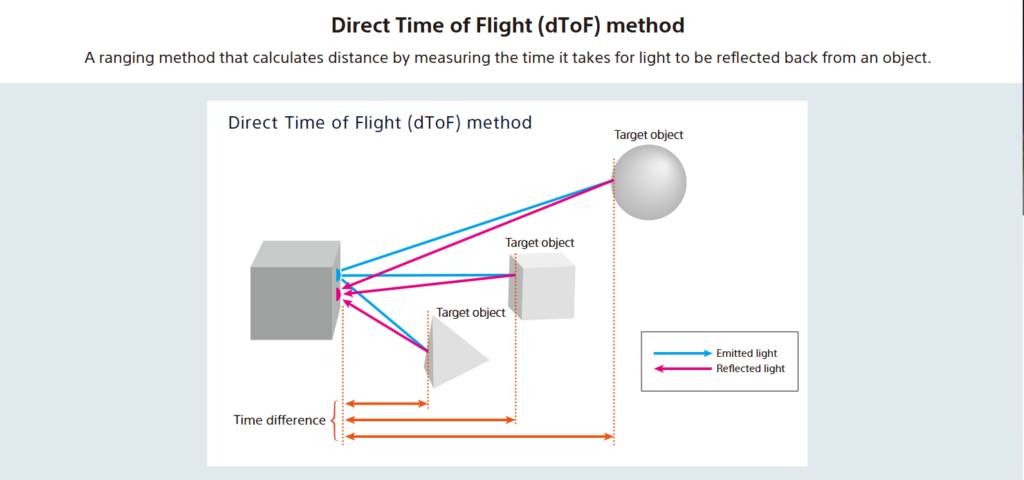
dTOF stands for direct Time-of-Flight, a cutting-edge depth sensing technology that captures distance by directly calculating the round-trip flight time of laser pulses. Unlike indirect solutions, dTOF abandons phase deviation calculation and relies on high-sensitivity single photon detectors to record photon movement in real time.
As the demand for outdoor high-precision perception rises, dTOF has gradually stood out from traditional iTOF. Its unique working mechanism gives it natural advantages in long-range detection, anti-light interference and environmental adaptability, making dTOF the preferred option for industrial-grade and outdoor autonomous devices.
Fundamental Working Principles of iTOF and dTOF
iTOF Working Principle
iTOF systems emit continuous wave light signals with a fixed modulation frequency f, and the receiving end measures the phase difference φ between the reflected signal and the transmitted signal. Distance is calculated using the formula:
d = (c · φ) / (4πf)
Where c represents the speed of light, f is the modulation frequency, and φ denotes the phase difference. Phase is typically calculated via multi-phase sampling methods such as the four-phase method. To extend the unambiguous ranging range, iTOF systems often adopt multi-frequency modulation and phase unwrapping algorithms to eliminate calculation ambiguity.
The main error sources of iTOF include multi-path interference (MPI), ambient light noise, and phase nonlinearity errors. These inherent flaws restrict iTOF to short-distance, controlled indoor environments, as it struggles to maintain accuracy in open outdoor spaces with strong sunlight or complex reflective surfaces.
dTOF Working Principle
dTOF systems calculate distance by measuring the round-trip time t of photons, with the core formula as follows:
d = (c · t) / 2
Typical implementations of dTOF rely on SPAD (Single-Photon Avalanche Diode) based time counting systems, combined with TDC (Time-to-Digital Converter) to achieve high-precision time measurement. dTOF systems usually generate a time histogram by counting multiple photon events, and estimate the final distance through peak detection or fitting algorithms to filter out invalid signals and noise.
The key challenges of dTOF include time resolution limitations, multi-photon pile-up effects, system power consumption constraints, and data bandwidth requirements. Despite these challenges, the technical advantages of dTOF make it irreplaceable for long-range and high-interference application scenarios, and optimized hardware designs can effectively mitigate these drawbacks.
Core Performance Comparison: iTOF vs dTOF
To clearly show the gap between the two technologies, we compare them from key practical dimensions:
- Detection Mechanism: iTOF uses phase shift calculation; dTOF adopts direct pulse time measurement
- Depth Resolution: iTOF delivers high dense resolution; dTOF offers balanced moderate resolution
- Effective Detection Range: iTOF suits short to medium range; dTOF performs well in medium and long range
- Anti-Multipath Interference: iTOF weak resistance; dTOF strong suppression ability
- Ambient Light Adaptability: iTOF only fits indoor dim light; dTOF works fine in strong outdoor sunlight
- Hardware Complexity: iTOF simple and low-cost; dTOF high-precision devices with higher technical threshold
- Typical Application Scenarios: iTOF for consumer electronics, indoor robots, face recognition; dTOF for industrial detection, outdoor drones, autonomous vehicles, long-range mapping
From actual performance, iTOF is more suitable for cost-sensitive closed indoor scenarios, while dTOF is tailored for industrial and outdoor projects pursuing stability, long range and strong anti-interference ability.
Typical Application Scenarios for iTOF and dTOF
iTOF Main Applications
iTOF is widely applied in consumer-level and indoor low-demand scenarios. Common uses include smartphone face unlocking, AR/VR spatial perception, indoor service robots, gesture control equipment and short-range industrial proximity detection. These scenarios focus on image fineness, with low requirements for outdoor anti-interference and ultra-long detection distance.
dTOF Main Applications
Thanks to its outstanding environmental adaptability, dTOF covers more high-end industrial and autonomous fields. It is widely used in outdoor navigation robots, agricultural machinery obstacle avoidance, drone terrain mapping, industrial high-precision ranging, smart traffic perception and unmanned vehicle lidar auxiliary sensing. In all harsh working environments where iTOF fails, dTOF can keep reliable running status all the time.
Introducing HM-LD1: Professional Industrial-Grade dTOF Sensor Module
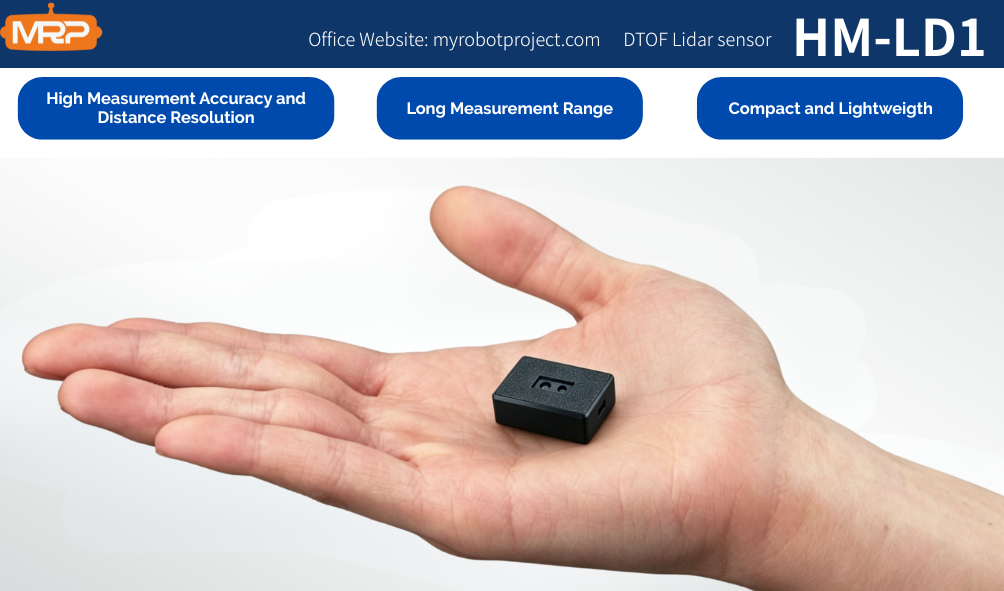
After fully understanding the technical differences, working principles and application boundaries between iTOF and dTOF, selecting a reliable dTOF hardware module becomes the core link for smooth project development and mass production. The HM‑LD1 is a high-performance dTOF solid‑state LiDAR independently developed for robotics, drone perception, obstacle avoidance and industrial ranging scenarios, built entirely around the native dTOF technical architecture.
Adopting high‑sensitivity SPAD detection and sub‑nanosecond light pulse emission, HM‑LD1 fully inherits the core strengths of dTOF technology, effectively solving pain points such as unstable ranging, poor sunlight resistance, and complex integration commonly seen in regular modules. It is purpose‑built for real‑time depth perception and 3D point cloud output in compact autonomous devices.
Core Specifications of HM‑LD1
- Sensing Technology: Direct dTOF + high‑sensitivity SPAD sensor
- Laser: 940 nm VCSEL, Class 1 eye‑safe
- Ranging Range: Indoor 0.5–25 m; Outdoor 0.2–8 m
- Ranging Accuracy: ±3 cm
- Field of View: 60° (H) × 45° (V)
- Resolution: 40 × 30
- Frame Rate: 10 fps
- Ambient Light Resistance: Up to 80,000 lux
- Interfaces: UART / UDP / UVC
- Power Consumption: 1.2 W @ 5 V
- Dimensions: 43.5 mm × 30 mm × 26.5 mm
- Weight: 28 g
- Operating Temperature: -20 ℃ to 60 ℃
Key Advantages of HM‑LD1
- True dTOF solid‑state design, no moving parts, high reliability and long service life.
- Outstanding anti‑ambient light performance, stable operation even in strong outdoor sunlight.
- Compact and lightweight, ideal for space‑ and weight‑sensitive robots, drones and portable devices.
- Rich interface and platform support: compatible with Windows, Linux, ARM, Android with official SDK.
- Factory calibrated, plug‑and‑play, minimal debugging for fast integration.
Conclusion
iTOF and dTOF occupy distinct positions in the 3D depth sensing industry, with clear application divisions. iTOF dominates low-cost, short-range indoor consumer scenarios relying on high-resolution dense depth maps, while dTOF has become the mainstream choice for high-precision, high-stability outdoor and industrial-grade perception thanks to its direct time measurement and strong anti-interference features.
If you are developing outdoor navigation, drone obstacle avoidance, industrial precision ranging or autonomous robot projects and need a compact, stable and professional dTOF solid‑state LiDAR, the HM‑LD1 is your ideal turnkey solution.
Learn more & order HM‑LD1: https://myrobotproject.com/product/dtof-solid-state-lidar-hm-ld1/