Introduction
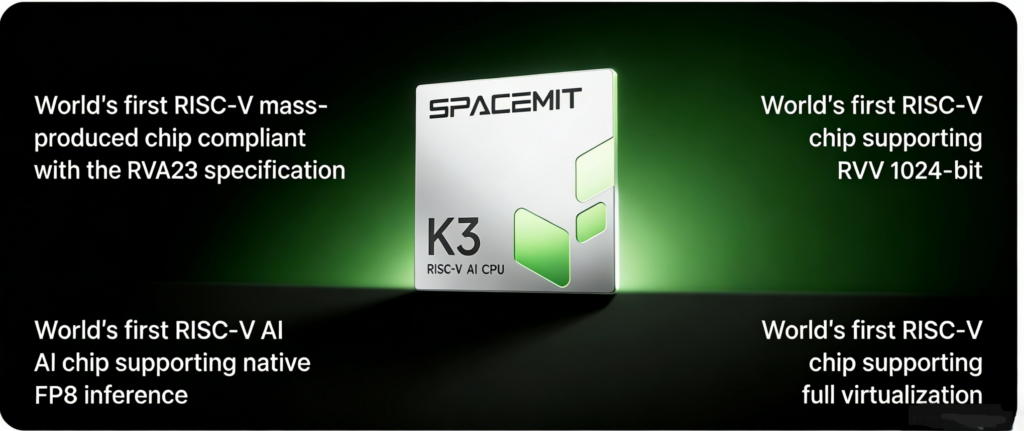
SpacemiT K3, the flagship AI CPU chip launched by Chinese RISC-V pioneer SpacemiT in January 2026, stands as the world’s first mass-produced RISC-V chip complying with the RVA23 specification—the high-performance application processor standard formulated by the RISC-V International Foundation. After 1200+ days of R&D, the K3 chip breaks the performance ceiling of the open RISC-V architecture with its innovative homogeneous fusion of general-purpose computing and AI computing power, filling the gap in high-performance edge computing power for domestic chips. It has successfully passed technical verification by national-level humanoid robot innovation centers and supports on-device inference of 30-80 billion parameter large language models (LLMs), becoming a core driving force for embodied intelligence and edge AI scenarios such as humanoid robots. This article details the K3 chip’s core technical specifications, scenario-optimized hardware interfaces, key technological innovations and practical application capabilities.
Core Technical Specifications of SpacemiT K3 Chip
The SpacemiT K3 chip is built with a highly optimized hardware architecture, balancing high performance, low latency and energy efficiency, with its core parameters reaching the level of mainstream commercial high-performance chips, and AI computing power achieving a qualitative leap compared with the previous generation K1 chip.
Computing Core Architecture
- High-performance general computing core: 8 self-developed X100 large cores adopting superscalar and out-of-order execution architecture, with a main frequency up to 2.4GHz. The single-core SPECInt2006 score reaches 9.41/GHz, and the Geekbench6 single-core score exceeds 400 points, equivalent to the performance of the ARM Cortex-A76/A78 series, realizing the first time that RISC-V has the ability to compete head-on with mainstream commercial architectures in general computing.
- Real-time computing subsystem: 2 self-developed RISC-V real-time computing cores dedicated to real-time control and computing, ensuring the ultra-low latency of embodied joint communication, which is the core hardware support for the high-dynamic and high-precision motion control of humanoid robots.
AI Computing Power & Data Precision
- AI computing capability: Integrated with a dedicated AI acceleration unit, it provides 60 TOPS of general AI computing power, which is 30 times that of the previous generation K1 chip.
- Native FP8 support: The world’s first RISC-V chip to achieve native AI inference with FP8 data precision. Compared with FP16, it halves memory usage and bandwidth requirements while maintaining more than 95% inference precision, and doubles computing energy efficiency—this is the key hardware foundation for efficient on-device LLM inference.
- LLM inference performance: It can smoothly run 30-80 billion parameter LLMs locally, with an output speed of 15 tokens per second and a first-token latency controlled within 1 second when running the 30B parameter Qwen model, breaking the limitation of traditional edge devices relying on cloud computing power.
Memory Subsystem
- High-speed tightly coupled memory (TCM): 3MB of high-speed TCM that can directly load the embodied RL motion control model, realizing high-speed inference and minimizing the latency of the control path.
- High-bandwidth external memory: Supports a maximum of 32GB LPDDR5 memory with a memory bandwidth of up to 204GB/s.
- Memory semantic caching technology: Innovatively introduced to automatically identify specific data access patterns in AI computing through hardware, the data prefetch hit rate is increased to more than 85%, effectively alleviating the “memory wall” limitation on AI computing performance.
Vector Processing Capability
Equipped with a 1024-bit vector register, it can operate 128 INT8, 64 INT16 or 32 FP32 data at one time, which is equivalent to executing 128 scalar instructions simultaneously. It supports multi-modal data fusion of images, point clouds, IMU and other sensors, greatly enhancing the robot’s environmental perception and understanding capabilities.
Power Consumption
The chip’s typical power consumption is controlled at 15-25W, achieving a perfect balance between high computing power and low power consumption, which is suitable for edge computing scenarios such as embedded devices and humanoid robots with strict power consumption constraints.
Rich Interfaces Optimized for Intelligent Application Scenarios
The SpacemiT K3 chip is designed with a variety of high-speed and industrial-grade hardware interfaces for the core needs of embodied intelligence such as humanoid robots, with a focus on reducing control latency and improving application scalability—its native communication interface design has been highly recognized in the national-level humanoid robot verification, significantly shortening the system control latency and improving algorithm efficiency.
Core Industrial Interfaces for Robots
- 10 x CANFD interfaces: A large number of CANFD bus interfaces are the key to connecting multiple joints and sensors of humanoid robots, supporting high-speed and reliable data transmission of robot motion control signals.
- 4 x Gigabit Ethernet interfaces: Support industrial real-time Ethernet protocols such as EtherCat and TSN, meeting the high-bandwidth and low-latency communication needs of complex intelligent robot systems.
Interface Design Advantages
All interfaces are natively integrated into the chip and optimized for robot motion control, avoiding the latency and complexity caused by external interface chips, and realizing the tight coupling of “computing + communication”—this is the core reason why the K3 chip can support the long-distance outdoor running test of humanoid robots and stable walking/ running in complex terrain.
Key Technological Innovations of SpacemiT K3
The K3 chip’s leading performance is based on a number of pioneering technological innovations, which not only push the RISC-V architecture into the high-performance computing field, but also create a new paradigm for edge AI computing.
- Global first RVA23 compliance: As the world’s first mass-produced RISC-V chip complying with the RVA23 specification, it solves the ecological fragmentation problem that has long restricted the development of RISC-V in high-performance fields such as servers and humanoid robots, and provides a unified “industrial standard” for the large-scale application of RISC-V in high-end computing scenarios.
- 1024-bit wide high-parallel computing: The world’s first mass-produced RISC-V chip with 1024-bit vector extension, realizing ultra-high parallel processing of multi-modal data, and laying a hardware foundation for the efficient fusion of robot sensor data.
- Homogeneous fusion computing paradigm: Under the unified RISC-V ISA and extension framework, it integrates high-performance general-purpose CPU and AI-optimized AI-CPU, running a single Linux operating system, supporting unified scheduling and resource governance with threads/tasks as the basic unit. This paradigm compresses the system fragmentation cost caused by heterogeneous computing into a controllable range, and realizes the system-level delivery of “one platform, one stack, one operations surface”.
- Full chip-level virtualization support: The first RISC-V product with complete chip-level virtualization support, greatly improving the resource isolation and security of the chip, and being suitable for complex edge computing scenarios such as industrial intelligence and multi-task AI inference.
Application Scenarios & Ecosystem Compatibility
Core Application Scenarios
The SpacemiT K3 chip is tailor-made for the era of embodied intelligence, with its performance and interface design highly adapted to humanoid robots, edge AI inference and industrial intelligence, and has achieved large-scale practical verification:
- Humanoid robots: It has been successfully applied to the core motion control systems of humanoid robots such as “Tiangong” and “Linglong”, completing stable walking, running and long-distance outdoor running tests in national-level innovation centers. It provides pure “Chinese power” for the high-dynamic and high-precision motion control of humanoid robots, and marks the independent and controllable of China’s high-performance humanoid robot motion control from chip to system.
- On-device LLM inference: Supports local inference of 30-80 billion parameter LLMs, and can be applied to intelligent scenarios such as multi-modal knowledge retrieval, intelligent meeting assistants and enterprise knowledge bases, realizing the “cloud-free” AI application of edge devices.
- Industrial intelligence & embedded computing: With its low power consumption, high real-time performance and rich industrial interfaces, it is suitable for industrial quality inspection, intelligent manufacturing, autonomous mobile robots (AMRs) and other scenarios.
Comprehensive Ecosystem Compatibility
SpacemiT K3 has built a complete full-stack computing system for the K3 chip, covering hardware, software and model ecology, greatly reducing the development threshold for customers:
- Operating system support: Compatible with Ubuntu, OpenHarmony, OpenKylin and SpacemiT’s self-optimized Bianbu Linux system. The basic operation speed such as OS startup and browser opening is close to the level of mainstream desktop CPUs. In February 2026, Canonical and SpacemiT reached a cooperation to fully support the K3 chip on the Ubuntu platform, realizing the deep integration of open source OS and RISC-V chip.
- LLM ecosystem compatibility: Supports all LLM formats on the HuggingFace platform except FP4/FP6, and is compatible with mainstream open source models such as Qwen and Deepseek, with a high degree of generalizability.
- Hardware supporting products: Launched supporting hardware such as PICO-ITX high-performance single-board computers, COM260 robot core boards and array servers, and opened all board-level reference designs to facilitate secondary development by customers.
- AI software stack: Built a dedicated AI software stack based on the SpacemiT K3 chip, supporting efficient deployment of various AI models and realizing the seamless connection between hardware computing power and algorithm applications.
Mass Production & Market Availability
- Technical verification: The SpacemiT K3 chip has successfully passed the high-standard physical machine verification of two national-level humanoid robot innovation centers, proving its ability to support the harsh requirements of humanoid robots for the fusion of extreme real-time control and complex AI computing, and having the conditions for large-scale mass production.
- Market launch: The SpacemiT K3 chip is scheduled to be officially launched and delivered in April 2026, and the relevant chip design details and software/hardware development materials will be gradually opened through the official website.
- Previous generation foundation: The previous generation K1 chip has a cumulative mass production of 150,000 pieces, becoming the leading product in the shipment volume of high-performance RISC-V chips in the open market, and its landing experience in open source intelligent hardware, AI robots and other fields has laid a solid market foundation for the large-scale promotion of the SpacemiT K3 chip.
- Capital support: SpacemiT has completed hundreds of millions of RMB in financing, providing sufficient capital support for the mass production, market promotion and subsequent R&D of the SpacemiT K3 chip.
Conclusion
The SpacemiT K3 chip is a milestone product in the development of the global RISC-V architecture, marking that RISC-V has officially entered the high-performance computing field from the low-end and mid-end embedded field. With its leading RVA23 compliance, 60 TOPS AI computing power, native FP8 support and scenario-optimized rich interfaces, the K3 chip not only realizes the independent and controllable of high-performance edge AI computing power in China, but also provides a high-performance, low-cost and open computing platform for the large-scale development of humanoid robots and embodied intelligence.
As the K3 chip is put into mass production and the ecological cooperation continues to expand, the application boundary of the RISC-V architecture in intelligent terminals, humanoid robots, industrial intelligence and other fields will be further broadened. SpacemiT’s full-stack computing system built around the SpacemiT K3 chip will also accelerate the innovation and landing of RISC-V-based applications, and push the open RISC-V ecosystem to a new stage of development.