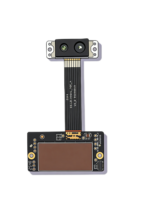
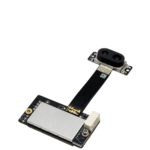
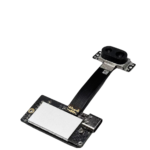
DTOF Solid state LiDAR HM-LD1 – DTOF SSL

  • DTOF Solid state LiDAR adopting Direct ToF technology with high sensitivity SPAD detection
  • Sub-nanosecond light pulse.
  • indoor:0.2m – 25m obstacle sensing(outdoor 0.2m-8m).
  • 940nm VCSEL Class 1 Eye Safety with 60°(H) x45°(V) FOV.

Original price was: $90.00.Current price is: $79.99.

DIMENSIONS

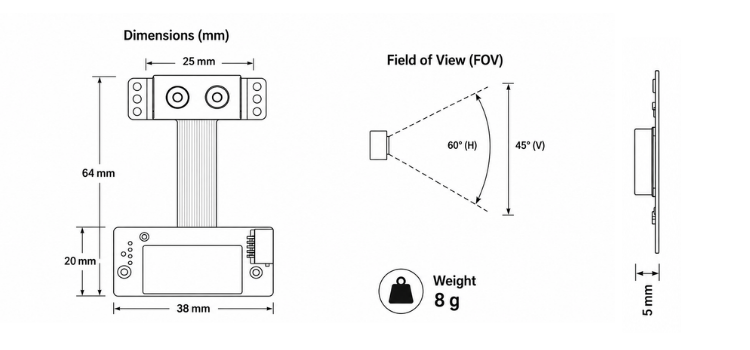
Dimension

43.5mm*30mm*26.5mm

Ranging Capability

Indoor: 0.5-25m; Outdoor: 0.2-8m

Ranging Accuracy

±3cm

FOV

60°(H) x45°(V)

Weight

8g

PRODUCT DETAILS

Resolution

40*30

Frame Rate

10fps

Interface

UART/UDP/UVC

Operating Temperature

-20 ℃ - 60 ℃

Power Consumption

1.2 W

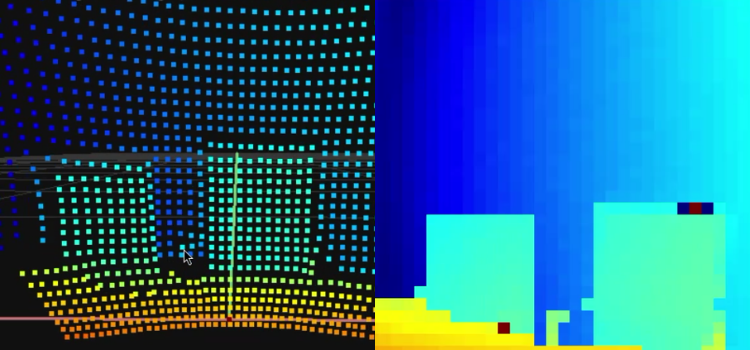
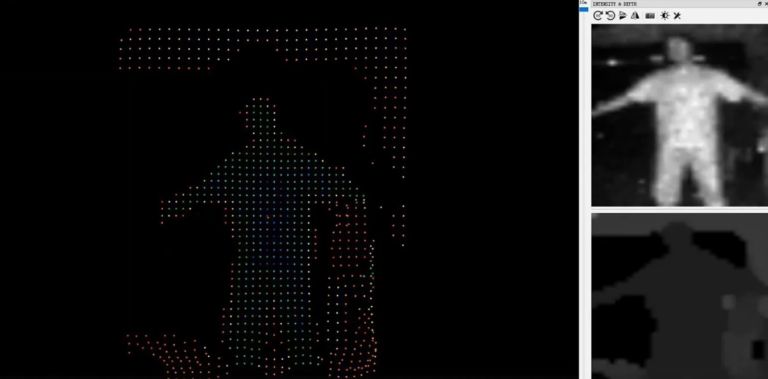
Point Cloud & Depth Map

An example of ranging measurement data displayed as point cloud and depth data 

DTOF Solid state LiDAR HM-LD1

Long Measurement Range

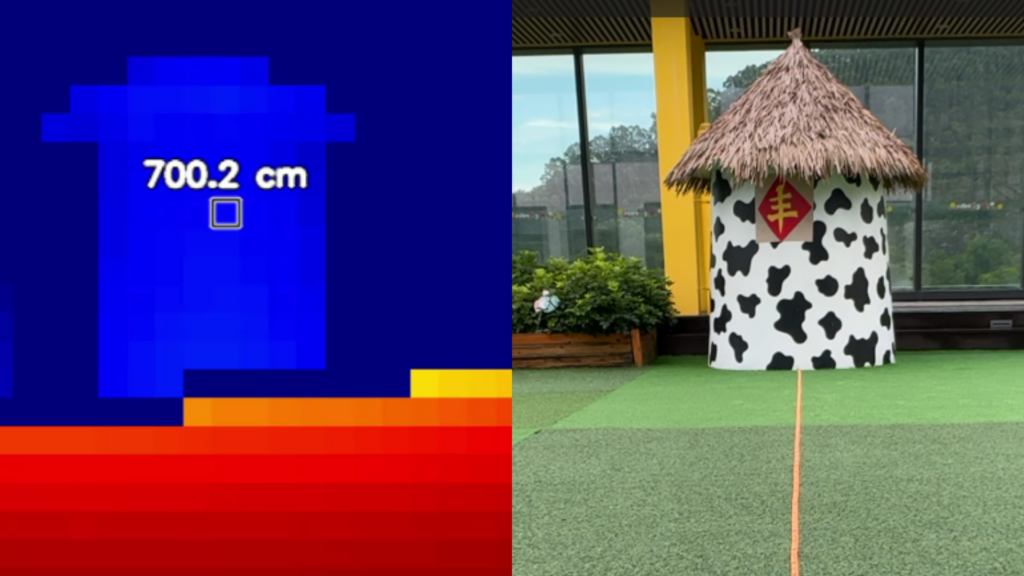
Its ranging measurement is highly accurate; even from a long distances of 8 meters on a clear summer day (assuming 80,000 lux). This measurement accuracy, from a distance even outdoors, makes it very useful to measure distances to objects that are difficult for people to approach, such as bridges, expressways, and dams.

HM-LD1 Dtof lidar

Compact And Lightweight

With 8 g in weight, this compact housing makes it easy to integrate into various devices, such as autonomous mobile robots with limited space for depth sensors, and drones where weight affects the flight distance.

HM-LD1 demission

Advanced 3D Sensing with Robust Environmental Adaptability

HM-LD1 is a solid-state LiDAR module based on SPAD dToF technology, delivering real-time depth images and 3D point cloud data for accurate environmental perception. It supports 0–25m ranging in indoor or nighttime conditions and 0–8m in outdoor daytime environments, making it suitable for obstacle avoidance, distance detection, autonomous navigation, smart inspection, and robotic vision development. With UVC, UDP, and UART interfaces, HM-LD1 can be easily integrated with PCs, Raspberry Pi, flight controllers, and embedded platforms for both prototyping and system deployment.

Multi-Scenario dToF LiDAR Applications

This dToF LiDAR module supports multiple applications for drones, robots, cameras, and security systems. It enables UAV altitude hold and terrain following, assists robot navigation, obstacle avoidance, and SLAM, while also supporting autofocus, user presence detection, object recognition, volume measurement, and zone intrusion monitoring.

Supports all kinds of development platforms

MRP offers SDKs for x86 Windows, x86 Linux, and arm Linux, enabling development and integration across diverse operating systems and architectures.

Why choose us

We specialize in perception and positioning modules for robots and UAVs, and are a world-leading supplier of navigation devices and solutions.

抓拍摄像机.png

Independent Research and Development Team

We have a professional independent R&D team, focusing on innovation of perception and positioning technology

热成像相机 (1).png

technical support services

Provide professional technical support for product integration and application

E90云台_画板 1.png

Direct manufacturing from the source factory

Manufactured by the original factory, with in-house production for stable supply

2000 万像素变焦相机.png

Customized products on demand

We customize products on demand and provide one-stop technical support

军用航空飞行器.png

Self-manufactured with steady supply guaranteed

In-house production for stable supply, supporting customized OEM/ODM needs

Core Strengths in Advanced Sensing Technology

Our core strengths lie in deep technical expertise across semiconductor devices, optical modules, and embedded algorithms. With strong capabilities in calibration, performance optimization, and eye-safety control, we deliver accurate and reliable sensor solutions. Through in-house R&D, firmware development, testing, and production, we ensure fast iteration, consistent quality, and dependable product performance.

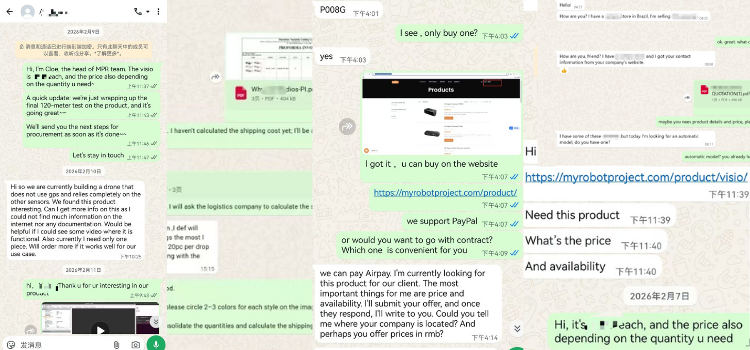
Customer Reviews

FAQ

1. Q: What ranging technology does HM-LD1 use?
A: HM-LD1 is based on direct Time-of-Flight (dToF) technology using a hybrid stacked SPAD (Single-Photon Avalanche Diode) sensor combined with a 940nm VCSEL emitter. This architecture enables precise time measurement of photon return, allowing accurate depth estimation and 3D perception.


2. Q: Is HM-LD1 considered a LiDAR sensor?
A: Yes. HM-LD1 is a solid-state LiDAR module that performs depth sensing without mechanical scanning. Unlike traditional rotating LiDAR systems, it uses an area-array architecture to directly output depth data and point cloud information.


3. Q: What is the effective ranging performance?
A: The module provides indoor range of 0.2 m – 25 m and outdoor range of 0.2 m – 8 m. Actual performance may vary depending on target reflectivity, ambient light, and environmental conditions.


4. Q: What level of accuracy can be expected?
A: HM-LD1 achieves a typical ranging accuracy of ±3 cm under standard operating conditions. Accuracy depends on factors such as surface properties, distance, and lighting environment.


5. Q: How does HM-LD1 perform under strong ambient light?
A: The sensor supports ambient light resistance up to 80 KLux, allowing stable operation in bright indoor and outdoor environments. However, extreme lighting conditions may still affect signal quality.


6. Q: What type of output data does the module provide?
A: HM-LD1 outputs depth data per pixel, point cloud visualization, and grayscale or intensity information depending on the interface mode. With a resolution of 40 × 30 and frame rate of 10 fps, it is suitable for real-time perception tasks.


7. Q: What interfaces and platforms are supported?
A: The module supports UART interface with communication protocols including UART, UDP, and UVC. It is compatible with Windows, Linux·, ARM, and Android platforms, making it suitable for embedded systems, UAVs, and robotics.


8. Q: What are the power and physical characteristics?
A: The module operates at 5V with approximately 1.2W power consumption and weighs around 5g, making it ideal for lightweight and power-constrained applications such as drones and mobile robots.

Applications

Robotic Dog

Education Research

Drone

Robot

Weight 0.028 kg
Interface

UART

,

UDP

,

UVC

Reviews

There are no reviews yet.

Be the first to review “DTOF Solid state LiDAR HM-LD1 – DTOF SSL”

Your email address will not be published. Required fields are marked *


Contact us

TEL: +8618926195421

Huangmei Road, Huangge Town, Nansha District, Guangzhou City, Guangdong Province, China 

Email:[email protected]