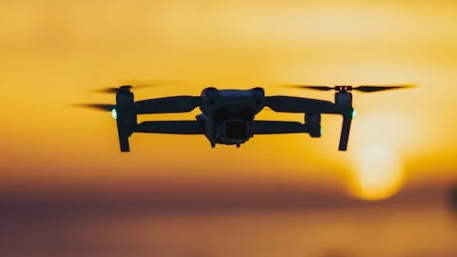
As drones evolve from consumer products to industrial-grade equipment, market demand for their sensing capabilities has increased significantly. Achieving autonomous flight in complex, dynamic 3D spaces requires precise and efficient navigation and recognition technologies—and the limitations of traditional solutions are driving vision and MEMS ToF technologies to become the next-generation answer.

1. Sensing Requirements for Industrial-Grade Drones: Overcoming Traditional Navigation Bottlenecks
Industrial drones are widely used in scenarios such as logistics delivery, equipment inspection, and topographic mapping. Their requirements for navigation accuracy and sensing robustness are far higher than those of consumer drones. Traditional navigation systems rely on sensors like IMUs (Inertial Measurement Units) and barometers, but they have clear limitations:
Accuracy Bottlenecks: IMU errors accumulate over time, leading to increased positioning deviations during long-duration flights;
Environmental Interference: Magnetometers are susceptible to electromagnetic interference, while barometers provide unstable data in complex airflows;
Poor Scene Adaptability: In complex environments such as indoor spaces, high-reflectivity areas, and low-light conditions, traditional sensors struggle to deliver reliable data.
Against this backdrop, vision systems centered on image sensors have gradually become a complementary solution, advancing drone intelligence to a higher level. In high-challenge scenarios like indoor spaces, the combination of MEMS ultrasonic ToF technology and AI vision is quickly becoming a standard sensing solution for industrial-grade drones.
2. Vision Systems: Reshaping Drones’ “Sensing Nerves”
Current mainstream drone vision systems consist of two core subsystems, which together support sensing needs in industrial scenarios:
2.1 Gimbal Systems: Task-Oriented Image Capture
Gimbals integrate multiple image sensors, covering a full spectrum from CMOS visible light to SWIR (Short-Wave Infrared), MWIR (Mid-Wave Infrared), and LWIR (Long-Wave Infrared). This enables adaptation to different lighting conditions and task requirements:
Visible Light Sensors: Suitable for daytime, well-lit outdoor scenarios, capturing high-definition environmental images;
Infrared Sensors: In low-visibility environments (e.g., nighttime, heavy smoke, smog), they still clearly capture target outlines and heat source information.
2.2 Visual Navigation Systems (VNS): Core Support for Autonomous Flight
Visual Navigation Systems (VNS) typically use image sensors with lower resolution but faster response times. Combined with IMU data, they achieve high-precision positioning and real-time obstacle avoidance through two key algorithms:
VIO (Visual-Inertial Odometry): Fuses visual and inertial data to correct IMU error accumulation, improving short-term navigation accuracy;
SLAM (Simultaneous Localization and Mapping): Analyzes sequences of images to build environmental maps in real time and determine the drone’s position—enabling autonomous navigation without pre-existing maps.
2.3 Technological Evolution of Image Sensors: Adapting to Drone Needs
To meet drones’ needs for miniaturization and low power consumption, current image sensors are evolving in three key directions to optimize overall performance:
Miniaturization: Reducing chip size to fit the limited payload space of drones;
Wide Dynamic Range & High Frame Rate: Handling complex lighting (e.g., strong light, backlighting) while capturing clear images of fast-moving targets;
Low Noise & Hardware Optimization: Integrating multi-exposure mechanisms (to expand dynamic range), SmartROI (Smart Region of Interest, optimizing bandwidth and power consumption), and on-chip noise reduction circuits to directly output high-quality images. This not only reduces the processing load of backend AI algorithms but also shortens model inference time, lowers system power consumption, and extends drone battery life.
Take ON Semiconductor’s Hyperlux series as an example: it offers differentiated products for different scenarios. The LP series focuses on low power consumption, meeting long-endurance needs; the LH series optimizes HDR performance for strong-light environments; the SWIR series supports infrared imaging, satisfying tasks in nighttime or low-visibility conditions. Together, these products fully cover the dual needs of visual navigation and task execution.

3. MEMS Ultrasonic ToF Technology: Unlocking Navigation Reliability in Complex Indoor Scenarios
Vision systems perform well in open outdoor environments, but in indoor scenarios with high reflectivity (e.g., glass curtain walls, reflective tiles), low light, and heavy obstructions, vision-only navigation often suffers from image misjudgments and missed obstacle detections—undermining flight stability. Here, MEMS ultrasonic ToF technology becomes a critical complement, with three core advantages:
3.1 Strong Anti-Interference Capability: Adapting to Complex Environments
Compared to infrared ToF, MEMS ultrasonic ToF distance measurement is not affected by target color, transparency, or light intensity:
It accurately detects objects that infrared ToF struggles with, such as glass, mirrors, and marble;
In extreme environments (e.g., total darkness, heavy smoke), it still stably outputs distance data, preventing navigation failure.
3.2 High Precision & Low Cost: Balancing Performance and Affordability
Ultrasonic ToF measures distance based on the principle of “sound wave speed × round-trip signal time.” Since the speed of sound (343 m/s) is only one-millionth that of light, the signal’s round-trip time is much longer—enabling sub-centimeter-level distance precision without the need for high-speed sampling or complex computing circuits. Additionally, low-power, low-cost processing units reduce the overall BOM cost of drones, making them suitable for large-scale industrial applications.
Currently, MEMS ultrasonic ToF chips from manufacturers like ON Semiconductor support operating frequencies ranging from 50 kHz to 178 kHz. Their distance measurement range covers the 5-meter span typically required for drone operations, balancing resolution and detection distance to fit indoor scenarios such as warehouses, shopping malls, and exhibition halls.
3.3 Collaboration with Vision Systems: Optimizing Overall Sensing Efficiency
In practical applications, MEMS ultrasonic ToF and vision systems form a “complementary collaboration” model to enhance system stability:
Infrared ToF or cameras provide rough environmental mapping for large-scale scene sensing;
MEMS ultrasonic ToF focuses on key obstacles (e.g., glass partitions, metal shelves), accurately outputting distance data to support obstacle avoidance decisions;
Even in areas where infrared ToF fails (e.g., glass display cases, reflective floors), ultrasonic ToF maintains navigation functionality. This avoids emergency maneuvers or energy waste caused by misjudgments, improving battery life efficiency.
4. Collaborative Innovation: Future Value of Vision and MEMS ToF Technologies
Drone application scenarios are expanding from outdoor to indoor and high-density spaces (e.g., warehouse sorting, shopping mall inspection, exhibition hall security). Requirements for sensing systems now go beyond traditional optics. The combination of vision systems and MEMS ultrasonic ToF technology not only addresses the scenario limitations of individual technologies but also delivers three core values:
Optimized Hardware Cost & Power Consumption: Highly integrated, low-power image sensors and MEMS ToF modules reduce overall drone BOM costs and power use, meeting the endurance needs of industrial-grade drones;
Enhanced AI Algorithm Efficiency: High-quality visual and distance data provide reliable input for AI inference algorithms, accelerating the implementation of autonomous navigation, target recognition, and task planning capabilities;
Expanded Application Boundaries: Anti-reflective and low-light-resistant sensing capabilities enable stable drone flight in complex indoor scenarios (e.g., warehouses, underground parking lots, exhibition halls), further opening up the industrial application market.
In the future, as AI algorithms evolve and sensor technology miniaturizes, the collaboration between vision and MEMS ToF will become even closer. This will continue to drive drone sensing systems toward “higher precision, greater reliability, and better adaptability to complex scenarios”—serving as a core driver for the intelligent upgrading of industrial-grade drones.