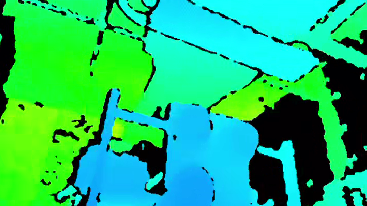
What is a Depth Camera?
A depth camera, also known as a 3D camera, is a device that accurately captures depth information of objects in a scene (i.e., the distance from the object to the camera). Unlike traditional cameras, which only capture 2D planar images, depth cameras not only record the color and texture of objects but also output their 3D spatial coordinates through specific technologies, enabling the construction of 3D models of scenes. The depth data they output is typically presented as a “depth map” — where the value of each pixel represents the distance from the corresponding object to the camera, with larger values indicating greater distance.


Technical Principles and Types of Depth Cameras
The core of a depth camera lies in calculating “distance” through technical means. Currently, mainstream technologies are categorized into three types: structured light, Time of Flight (ToF), and stereo vision.
1. Structured Light Depth Cameras
Technical Principle: A structured light camera projects specific light patterns (such as stripes or dot matrices) onto the target scene, then uses an infrared camera to capture the “deformed” patterns modulated by the object’s surface. Due to variations in object shapes, the deformation of the light patterns differs across positions. By comparing the differences between the original projected pattern and the received deformed pattern, combined with triangulation principles, the depth information of each point can be calculated.
Technical Details: Cameras in the iHawk series adopt innovative metasurface-integrated optical technology, achieving significant breakthroughs compared to traditional RGB-D 3D depth cameras. By integrating a self-developed polarizer into the camera, they effectively reduce interference from multipath reflection and specular reflection, solving long-standing technical challenges in the industry.
Typical Applications: The first-generation Microsoft Kinect famously used this technology. In gaming, it can capture players’ movements in real time, enabling motion-sensing interactions (e.g., controlling game characters with hand gestures). In industrial inspection, it can detect surface defects (such as bumps or scratches) by comparing 3D models of products.
2. Time of Flight (ToF) Depth Cameras
Technical Principle: ToF cameras calculate distance by measuring the “round-trip time” of light. The camera emits infrared light pulses, which reflect off objects and are received back. Using the formula d = c × t / 2 (where d is distance, c is the speed of light, and t is the round-trip time), the distance from the object to the camera can be computed.
Technical Details: Performance depends on light pulse power, sensor sensitivity, and time measurement accuracy. High-precision time-to-digital converters (TDCs) improve measurement precision, while optical filters in front of the lens reduce ambient light interference by allowing only specific wavelengths of infrared light to pass through.
Typical Applications: ToF cameras in smartphones (e.g., models by Huawei and Samsung) enable natural background blurring (by accurately distinguishing foreground and background). In autonomous driving, they real-time detect the distance and position of obstacles, providing environmental perception data for vehicle decision-making.
3. Stereo Vision Depth Cameras
Technical Principle: Mimicking human binocular vision, stereo vision cameras use two (or more) cameras to capture the same scene from different angles. By matching identical feature points in the two images and applying triangulation principles (using baseline distance and parallax), depth information is calculated.
Technical Details: Accuracy is related to baseline distance (distance between the two cameras), focal length, and resolution — a larger baseline expands measurement range and improves precision but increases cost and size. Feature matching often uses algorithms like SIFT or SURF.
Typical Applications: Robots equipped with stereo vision can achieve autonomous navigation and obstacle avoidance (by building 3D environmental maps). In 3D filmmaking, this technology captures stereoscopic footage, creating an immersive experience when viewed with 3D glasses.
Key Applications of Depth Cameras
Leveraging their ability to capture 3D information, depth cameras are widely used in smart homes, healthcare, VR/AR, industrial manufacturing, and security monitoring.
1. Smart Homes: Personalized Scenes and Energy Efficiency
- Human Behavior Recognition: By capturing user movements and postures, it automatically adjusts lighting (e.g., activating soft nightlights for midnight trips to the bathroom) and air conditioning (e.g., setting temperatures to 26°C based on user clothing and room conditions).
- Contactless Interaction: Recognizes hand gestures to control TVs (channel switching, volume adjustment) or supports motion-sensing games (e.g., real-time tracking of movements in dance games).
- Energy Optimization: Automatically turns off appliances when no one is present, reducing energy waste.
2. Healthcare: Precise Surgery and Rehabilitation Assistance
- Surgical Navigation:
- Orthopedic Surgery (e.g., hip replacement): Preoperatively scans 3D bone models to plan prosthesis placement; intraoperatively monitors the position of instruments relative to bones to avoid damaging nerves and blood vessels.
- Neurosurgery (e.g., brain tumor resection): Combines MRI/CT data to clearly show tumor relationships with surrounding tissues, alerting surgeons when instruments approach critical nerves.
- Rehabilitation Therapy:
- Motion Assessment: Uses stereo vision to record joint angles and movement ranges of stroke patients, objectively evaluating recovery progress.
- Real-Time Guidance: Corrects movement deviations (e.g., upper limb extension trajectories) during training to ensure rehabilitation effectiveness.
3. VR/AR: Immersive Experiences and Virtual-Real Integration
- VR Applications:
- Gaming: In Beat Saber, ToF or structured light technology tracks players’ movements, precisely mapping physical actions to virtual light saber swings.
- Education: In medical anatomy teaching, hand movements are tracked to rotate and zoom virtual human models, enhancing learning engagement.
- AR Applications:
- Navigation: Mobile AR navigation uses stereo vision to overlay virtual arrows onto real roads, providing intuitive directions.
- Shopping: Scans room spaces to “place” virtual furniture, allowing users to preview size and style compatibility.
4. Industrial Manufacturing: Quality Inspection, Modeling, and Automated Assembly
- Quality Inspection:
- Dimensional Deviations: Structured light technology inspects automotive engine block bore diameters and wall thicknesses with micrometer-level precision.
- Surface Defects: ToF technology identifies tiny cracks and scratches on aircraft engine blades.
- 3D Modeling:
- Product Design: Scans prototypes to generate 3D models, which are imported into CAD software for optimizing appearance and structure.
- Reverse Engineering: Scans old molds to generate 3D data for replication or improvement.
- Robotic Assembly:
- Part Grasping: ToF technology guides robots to precisely pick up tiny capacitors (mm-scale) on smartphone motherboards.
- Precision Assembly: Structured light technology aligns bolt holes of car cylinder heads and blocks, improving assembly accuracy.
5. Security Monitoring: Intelligent Alerts and Precision Management
- Intrusion Detection: ToF technology monitors residential perimeters and restricted areas (e.g., military bases), identifying climbing or trespassing and triggering alarms.
- People Counting:
- Crowd Monitoring: Stereo vision distinguishes individuals in dense crowds (e.g., subway stations, malls), avoiding undercounting/overcounting and alerting to congestion risks.
- Attendance Management: Campuses/offices use 3D feature matching for contactless check-ins, preventing proxy punching.
- Abnormal Behavior Alerts:
- Public Spaces: Identifies actions like running or falling, prompting security personnel to respond.
- Elderly Care: Monitors falls or prolonged inactivity among seniors, sending alerts to families for timely assistance.
Frequently Asked Questions (FAQ)
Q: What is the core difference between depth cameras and ordinary cameras?
A: Ordinary cameras only record 2D images (color, texture), while depth cameras additionally capture distance information from objects to the camera, enabling 3D model construction.
Q: Do depth cameras invade privacy?
A: In most scenarios, only depth information (not image content) is collected. For example, in elderly care monitoring, it analyzes movement postures without recording specific visuals, protecting privacy.