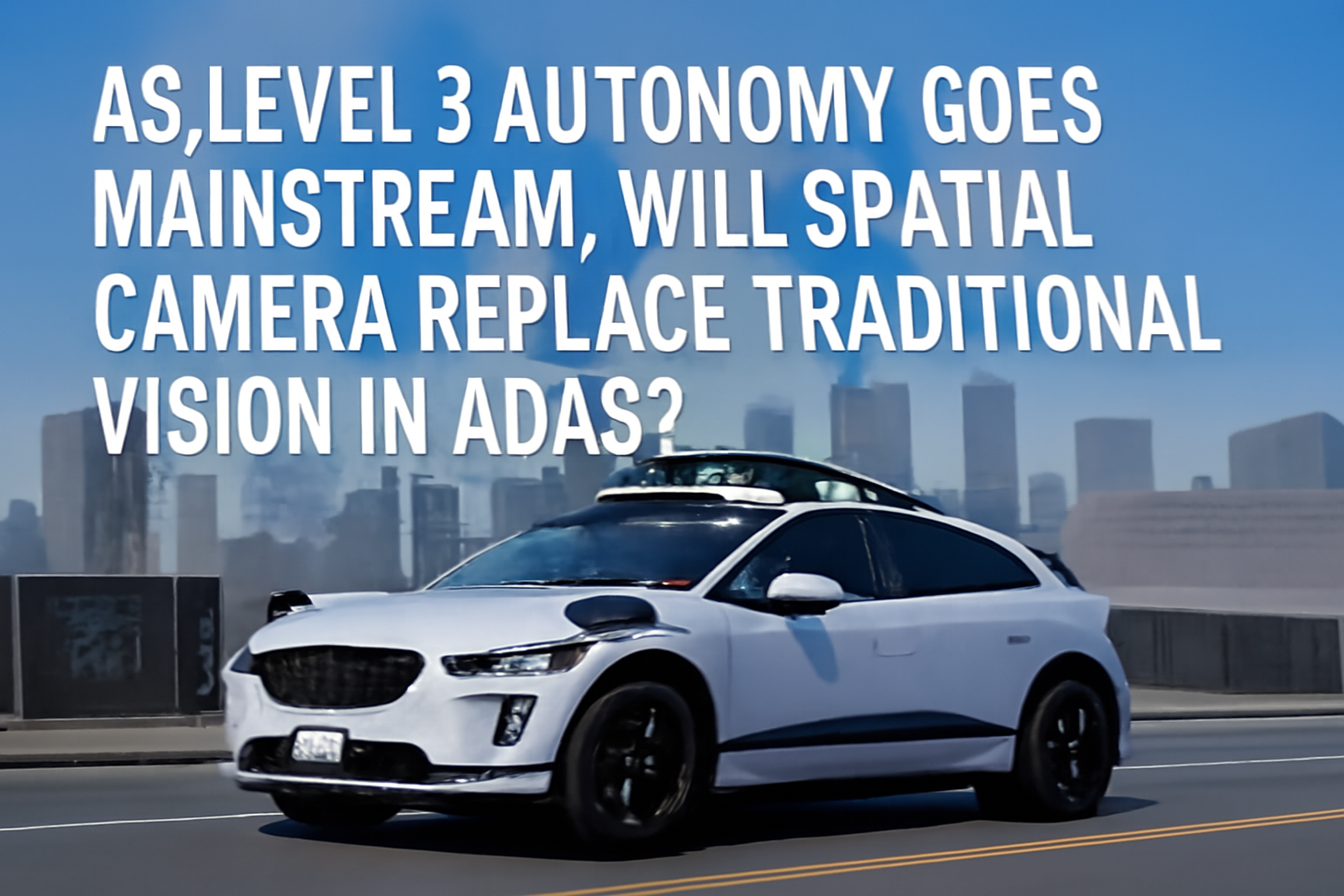

With Level 3 autonomous driving gaining regulatory approval across Europe, Japan, and parts of the U.S., the spatial camera is receiving significant attention. Far from being a niche technology in robotics or AR, the spatial camera is now emerging as a cornerstone of advanced driver‑assistance systems (ADAS). This article explores how the 3D camera could revolutionize vehicle perception in a post‑LiDAR automotive landscape.
1. Market Dynamics: The Rise of Spatial Camera Systems
Automakers are accelerating toward full-stack autonomy, starting with incremental levels like L2+ and L3. In this evolution, the spatial camera is surpassing stereo-vision systems thanks to its compact form and real-time 3D perception. Recent prototypes using 3D cameras showcase centimeter-level depth accuracy—vital in urban environments. Many OEMs now pilot its modules for lane changes, obstacle detection, adaptive cruise, and emergency braking under diverse lighting conditions.
Why it makes sense:
- Cost advantage: Camera modules cost 10–20× less than mechanical LiDAR.
- Versatile mounting: Compact design enables integration in grilles, side mirrors, and bumpers.
- Redundancy efficiency: Multiple cameras can build a 360° surround package without heavy LiDAR infrastructure.
2. Market Dynamics: The Rise of Spatial Camera Systems
Automakers are rapidly progressing toward full-stack autonomy, initiating with incremental but critical steps like L2+ and L3. In this journey, the spatial camera is emerging as a favorable alternative to stereo-vision systems due to its compact size and built-in 3D depth sensing capabilities. Specifications from recent prototypes indicate sub-10 cm depth accuracy—sufficient for urban environments. Manufacturers are testing these devices for key ADAS features: lane detection, adaptive cruise, collision avoidance.
Regulatory backing adds momentum: Japan’s 2020 modernization of the Road Traffic Act legalized L3 driving, and Germany finalized UN‑R157 technical rules in early 2021, enabling hands-off highway autonomy up to 60 km/h. Market forecasts expect L3-capable vehicles to grow from 291,000 units in 2025 to 8.7 million by 2035. As consumers and cities demand intelligent safety systems, the spatial camera offers a blend of performance and affordability unmatched by bulky LiDAR systems.

3. Technology Edge: What Gives the Spatial Camera an Advantage?
Traditional vision systems infer depth through image processing, but the spatial camera embeds depth sensing in hardware—via structured light or Time-of-Flight (ToF)—for direct 3D capture. This reduces algorithm load and increases reliability.
Structured-light spatial cameras project coded patterns and triangulate surface geometry, yielding high-resolution depth data even in low-light conditions . In contrast, ToF spatial cameras operate faster (15–30 fps) and are better suited for real-time moving scenarios, with consistent depth accuracy across scales.
Stereo vision, while cheaper, depends on image texture and loses accuracy in featureless or low-light scenes. Spatial camera technology bypasses that limitation. When paired with modern edge AI platforms such as NVIDIA Orin, spatial camera data enables rapid classification, tracking, and autonomy-critical decision support. This hardware–software synergy makes the 3D camera a powerful enabler for safe L3 driving.
4. The Bottom Line: Smarter Perception, Not Heavier Hardware
As the automotive industry pivot toward software-defined vehicles, the spatial camera becomes a lightweight, intelligent sensor choice. Declining costs and rising performance ease its integration. Growing annotated 3D datasets also sharpen camera models, enhancing classification accuracy and predictive capabilities.
It has evolved from passive element to active, embedded decision-maker in the ADAS stack.

5. Spotlight: Berxel Photonics’ P Series Structured‑Light Spatial Cameras
For those needing a high-precision, compact spatial camera for ADAS, robotics, or inspection tasks, Berxel Photonics’ P Series stands out.
- Depth Range: 0.3 – 8.0 m (P100R model)
- Resolution & Frame Rate: 1280×800 @7 fps or 640×400 @30 fps, with synchronized RGB + depth
- Precision: ~1 mm depth error at 60 cm
- Compact Design: 90×25×25 mm, USB‑C powered (<2.2 W), Class‑1 laser safe
- Polarized VCSEL Structured‑Light: 1000× polarization extinction ratio reduces reflections in automotive-grade materials
- Rugged Build: Operates from –10 °C to 60 °C, suitable for embedded and on‑vehicle integration
Ideal use cases include short-range surround-view sensing, robotic bin-picking, industrial part inspection, and AR/VR depth support.