When an autonomous forklift precisely lifts a coded carton, or a robotic arm accurately grasps parts of the same color—these feats rely on a “cutting-edge technology” called the RGB-D camera. More than just an image-capturing device, it serves as the “eyes” and even a part of the “brain” for machines, completely redefining the boundaries of traditional automation. Today, let’s dive deep into this innovative technology and uncover its secrets.


1. What is an RGB-D Camera? Exploring Its Core Composition
To understand an RGB-D camera, we need to break down the meanings of “RGB” and “D” separately.
① RGB: Capturing the Colorful World
RGB refers to an RGB camera—the familiar color camera used in daily life. It captures and displays the shape and color of objects. It is called an RGB camera because it synthesizes full-color images by capturing light from three primary color bands: Red, Green, and Blue. These three colors correspond to the wavelengths most sensitive to the cone cells in the human retina; their combination can reproduce most visible colors, providing rich visual information for machines.
② D: Detecting Depth Information
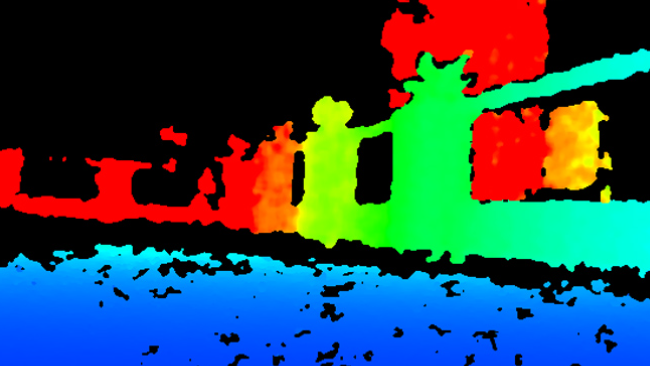
“D” stands for Depth Camera. Unlike RGB cameras, which capture 2D images, depth cameras measure the distance (or depth) of objects from the camera using various principles (such as structured light, Time-of-Flight (ToF), and stereo vision). The depth map generated by a depth camera includes precise depth data for every pixel, granting machines 3D spatial perception capabilities.
Thus, an RGB-D camera is, as its name suggests, a composite visual sensor that seamlessly integrates an RGB color camera with a depth camera. It simultaneously captures both color information and 3D spatial depth data, offering more comprehensive data support for machines’ intelligent decision-making.
2. How Do RGB-D Cameras Work in Tandem?
The working principle of an RGB-D camera lies in its data fusion capability. Through algorithms (typically rigid alignment or registration), it precisely aligns the color images captured by the RGB camera with the depth point cloud data (or depth map) from the depth camera. The resulting RGB-D image not only clearly shows the object’s color and shape but also provides accurate depth information for each pixel. This unique combination enables machines to understand their environment and target objects more comprehensively and accurately.
3. Why Are RGB-D Cameras So Critical? Core Advantages and Applications
In industrial automation, robotics, and many cutting-edge fields, RGB-D cameras are becoming increasingly indispensable.
Enhancing Object Recognition and Detection Accuracy
By fusing 3D point cloud/depth map data from the depth camera with RGB color data, systems gain both color and depth information, significantly improving the accuracy of object recognition and detection. In complex environments where targets and backgrounds have highly similar colors, relying solely on 2D images for recognition consumes excessive labor and computing power while yielding poor results. RGB-D cameras, however, use depth information to precisely distinguish target objects from backgrounds within the working distance (e.g., ignoring overly distant backgrounds).
Reducing Computational Load and Optimizing Efficiency
RGB-D images allow systems to precisely isolate objects of interest and cut out irrelevant backgrounds. This “region of interest” localization drastically reduces the computational power required by processors, boosting overall efficiency—a critical advantage for automation systems needing real-time responsiveness and high productivity.
Versatile Applications
RGB-D cameras excel in the following scenarios:
- Vision-guided robotic grasping: Enabling precise manipulation of irregularly shaped or randomly placed objects.
- Mobile robot navigation and obstacle avoidance: Providing accurate 3D perception for robots to navigate and avoid obstacles in complex environments.
- Pallet and cargo identification: Improving efficiency in goods recognition and inventory management for logistics and warehousing automation.
- Remote patient monitoring: Non-contact tracking of patient posture and behavior for safer care.
- AR/VR and motion sensing: Delivering more realistic interaction experiences in virtual and augmented reality applications.
- 3D scanning and volume measurement: Enabling high-precision 3D reconstruction and object volume calculation.
4. iHawkP100R/iHawkP050: Innovators in Structured Light Depth Cameras
iHawkP100R: Long-Range, High-Precision Depth Perception
The iHawkP100R is a monocular 3D structured light camera module. It delivers high-precision depth information from 0.3m to 8m and simultaneously outputs high-precision depth maps and HD color images. Ideal for mid-to-long-range applications requiring accurate perception, it is widely used in robot obstacle avoidance, visual recognition, volume measurement, 3D scanning, AR/VR, and motion sensing.
iHawkP050: Ultra-High-Precision 3D Capture for Short Distances
The iHawkP050 provides high-precision depth data from 0.07m to 0.50m, also outputting high-precision depth maps and HD color images. It is particularly suited for close-range applications demanding extreme accuracy.
Core Technical Advantages of Bosheng’s Products
Hardware Advantages: Delivers high-precision depth maps, full HD color images, and supports pixel alignment of images, ensuring high-quality and synchronized data.
Software Advantages: Requires no computing power from the backend platform—all depth calculations are completed within the module, significantly reducing the computational burden on clients’ devices. Additionally, Bosheng offers a self-developed, cross-platform SDK supporting Android, Windows, and Linux, enabling clients to quickly develop industry-specific edge applications.
Moreover, unlike other global RGB-D 3D depth cameras, Bosheng’s cameras utilize metasurface technology for optical integration at the chip and device levels. This perfectly addresses pain points in 3D sensing scenarios, such as multipath reflection and specular reflection, overcoming long-standing challenges in the 3D depth camera industry and providing clients with more stable and reliable depth perception solutions.